
Commercial roofing
Commercial roofing for commercial and industrial buildings in Brampton.
Brampton's logistics roofs are among the largest single roof areas in Ontario, and almost none of them can be shut down to be replaced.
NorthCan Roofing replaces, repairs and maintains flat roofs on Brampton's distribution and manufacturing buildings. The defining feature here is scale: very large single-ply roofs over long-span decks, where uplift resistance at the perimeter and corners and phasing around a running operation matter more than membrane brand.
Brampton's employment lands run in a broad band across the south and east of the city, around Steeles and Torbram, along Airport Road, through Bramalea and out to Highway 410 and Mayfield. The dominant building type is the large-format distribution centre and food or manufacturing plant, much of it built from the 1990s onward and a great deal of it in the last two decades.
The roof assembly is consistent: steel deck on long-span joists, a vapour retarder, two or more layers of polyisocyanurate insulation, and a mechanically attached or induction-welded TPO or EPDM membrane. Penetrations are sparse relative to the area, drainage is internal with tapered crickets between drains, and the field can run for a very long distance without interruption.
That geometry produces a particular failure pattern. The field membrane on a modern building tends to outlast the details. What gives out first is the perimeter edge metal, the terminations at parapets and roof-to-wall junctions, the seams where sheets meet at odd angles near corners, and the curbs under exhaust fans and refrigeration equipment. A great deal of useful Brampton roofing work is therefore detail work on a roof whose field is still perfectly sound.
Because that is where wind suction is highest. Air flowing over the edge of a large low building separates and forms vortices at the corners, producing negative pressures several times higher than in the middle of the roof. Roofing systems are consequently designed in zones: the corner zone needs the densest fastening, the perimeter zone the next densest, and the field the least. On a very wide Brampton roof, the field zone is enormous and the corner zone is small, which tempts people into treating the whole roof as one specification. That is exactly how roofs peel.
The Ontario Building Code sets hourly wind pressures by municipality in its climatic design data, Supplementary Standard SB-1, and those values feed the uplift design. What we look at on site is whether the existing edge condition matches the zone it sits in: continuous cleat rather than face-fastened drip, sound wood nailer anchored to the deck or wall, correct fastener spacing, and terminations that do not rely on sealant alone. Where a roof has previously been re-covered, the nailer is frequently the original and the weakest part of the assembly.
The other Brampton-specific loading item is drift. Long buildings with tall office fronts, penthouse mechanical rooms and screen walls create drift zones along a small part of a very large roof, and those strips need checking after a heavy fall even when the field is bare.
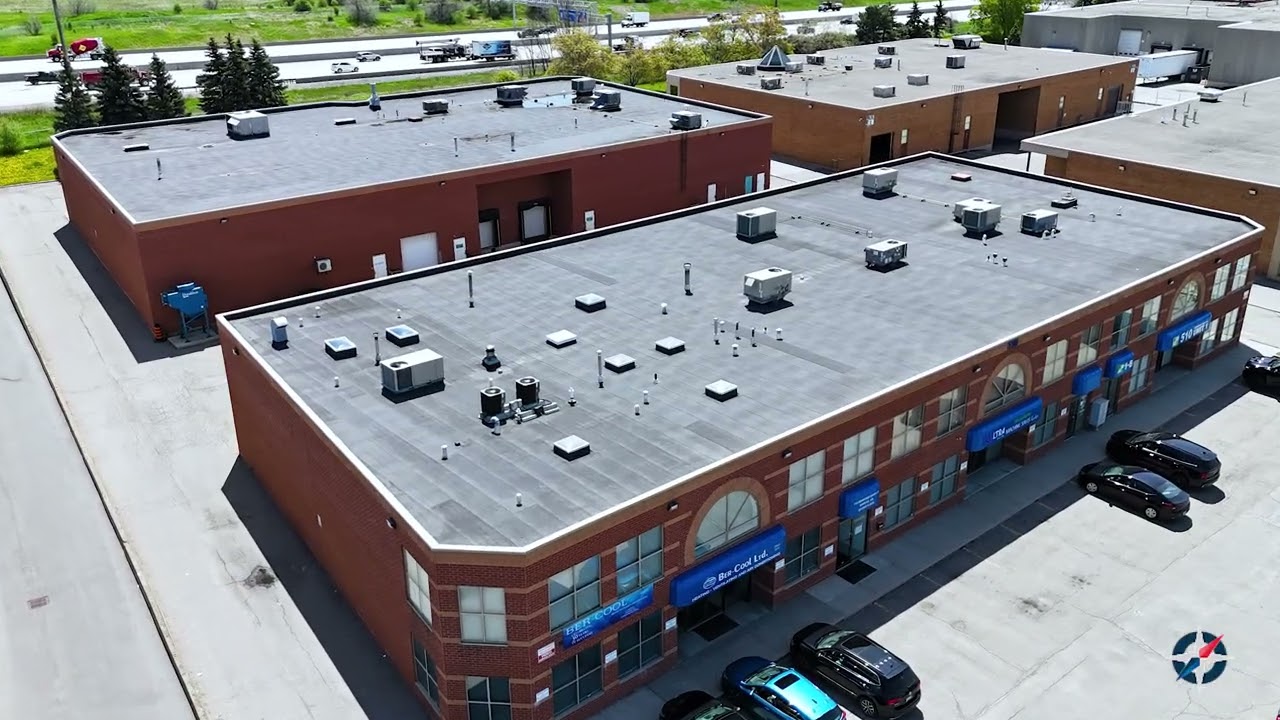
Phasing is the whole job. The method we use on large Brampton buildings is to divide the roof into daily sections that a defined crew can tear off, insulate, membrane and close watertight within one shift, then to sequence those sections so that work moves away from the busiest dock doors and never sits above a live pick face.
The work itself is industrial roofing and large-area flat roof replacement, with edge metal and flashing upgrades usually forming a separate, carefully priced part of the scope. For planning purposes the flat roof cost calculator will give you a working area-based figure before we survey.
Crews, materials and equipment dispatch from 425 Alness Street in Toronto. There is no Brampton office, no Brampton yard and no local Brampton number; every call comes to 416-456-0777. The route is west on Highway 407 or 401 and north, and Brampton is far enough that we plan large jobs as continuous multi-day mobilisations with material staged on site rather than as a series of short visits.
That has a real consequence for how we quote. On a Brampton distribution roof, sending a small crew for many short days costs the client more in mobilisation than sending a properly sized crew for a compressed programme. For water entering a warehouse overnight, the 24/7 line and emergency roof repairs are the right route. Nearby we also cover Mississauga and Vaughan, with the full list on the service areas page.
Brampton runs a dedicated stream for industrial, commercial, institutional and high-rise projects, covering new buildings and additions, unit and interior finishes, change of use, demolition, signs, temporary tents and backflow prevention devices. Roof replacement is not listed as its own permit category, which is consistent with the general Ontario position that like-for-like roofing without structural work does not require a permit while structural alterations do.
On a large Brampton warehouse, the structural trigger is common: replacing corroded deck sections, adding or relocating heavy rooftop equipment, cutting new openings for skylights or smoke vents, or reinforcing for a heavier assembly. Any of those needs engineered drawings and a permit. Check the City's industrial, commercial and institutional permits page and speak to Brampton Building before you set a start date. Our wider commercial capability is described on the commercial roofing page and you can start with an estimate request.
Both are defensible and the right answer depends on the roof's condition map, not on preference. If moisture scanning shows wet insulation spread across the roof and the deck is corroding, splitting the work over three budget years means paying to protect and re-detail temporary tie-in edges each year, and leaving a deteriorating roof in service in between. Replace it in one programme.
If the roof is dry across most of its area with a defined bad quadrant, a phased programme makes good sense, provided the tie-in between new and old is detailed as a permanent edge rather than a temporary one and provided the phases run in the right order. We map the roof, agree the phase boundaries at fire walls or expansion joints where possible, and set out what each phase leaves behind. What we will not do is phase a roof simply to make a first-year number look smaller.
Commercial roofing for commercial and industrial buildings in Brampton.
Flat roof repairs for commercial and industrial buildings in Brampton.
Emergency roof repairs for commercial and industrial buildings in Brampton.
Flat roof replacement for commercial and industrial buildings in Brampton.
Roof installation & replacement for commercial and industrial buildings in Brampton.
Roof inspections for commercial and industrial buildings in Brampton.
That is the normal way we do it. The roof is divided into sections a crew can open and close watertight in one shift, sequenced away from active dock doors and never left open above a live pick face. Interior protection, magnetic sweeps for dropped fasteners, and debris chutes clear of truck circulation are part of the plan, along with locating sprinkler mains before any deck work.
Because the perimeter and corner zones carry the highest wind suction on a large low-slope roof and need the densest fastening, sound nailers anchored into the structure, and continuous cleat rather than face-fastened metal. On a re-covered roof the nailer is often original and has to be replaced. It is a small fraction of the area and a large fraction of the risk of the roof coming off.
It depends on whether structural work is included. Brampton's ICI permit stream covers new buildings, additions, interior finishes, change of use, demolition, signs, tents and backflow devices rather than listing re-roofing separately. Deck replacement, new roof openings and new or relocated heavy rooftop equipment do involve structural work and engineered drawings. Confirm your scope with Brampton Building.
Probably. On modern Brampton warehouse roofs the field membrane commonly outlives the details, and curbs, edge metal and terminations fail first. If seam probing and moisture scanning show a dry, sound field, rebuilding the failing details is the proportionate response. Replacement is the right call when moisture is spread across the field or seams fail away from penetrations.
Tell us the address, the roof size and what you are seeing. We will book a time to get up there and put it in writing.
Call 416-456-0777 for anything urgent. Our emergency line is answered around the clock.
Call 416-456-0777