Vapour retarder and condensation diagnosis on flex units where the office and warehouse conditions differ.
Commercial and Industrial Flat Roofing in Burlington
Burlington's flex office-industrial units combine a warm office end and a cold warehouse end under one continuous roof, and the roof feels the difference.
What does Burlington's business park stock look like?
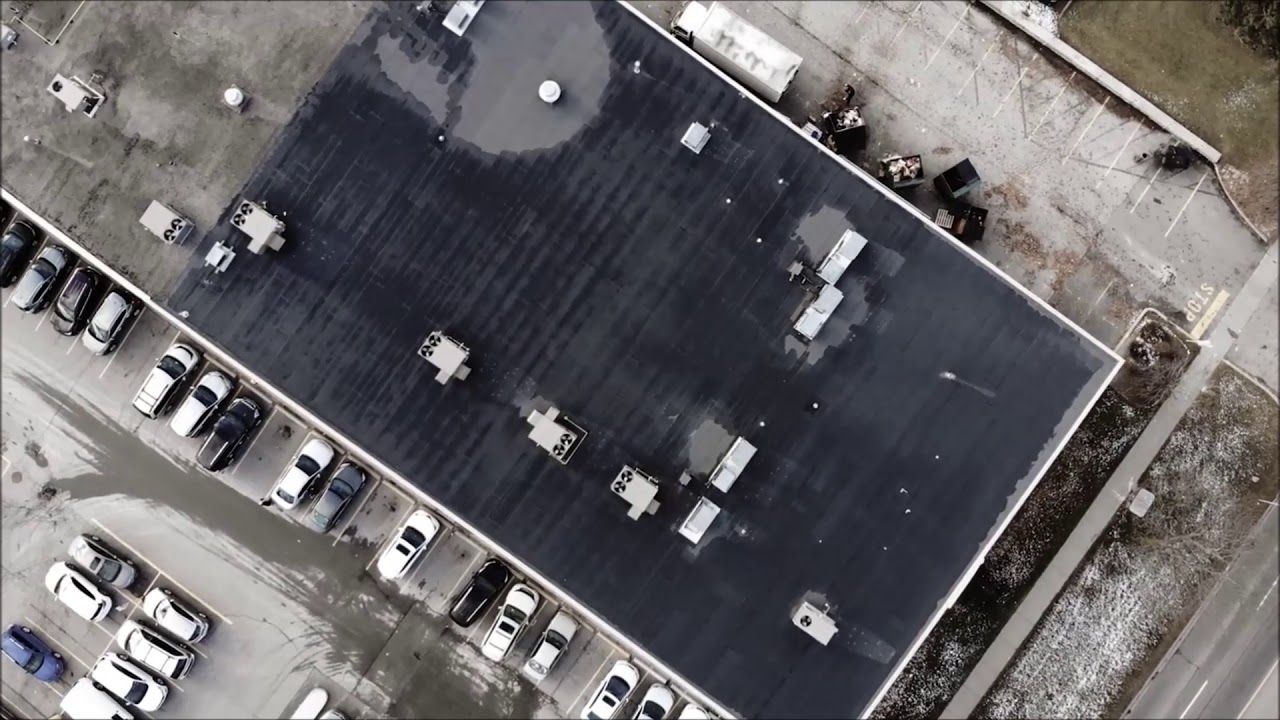
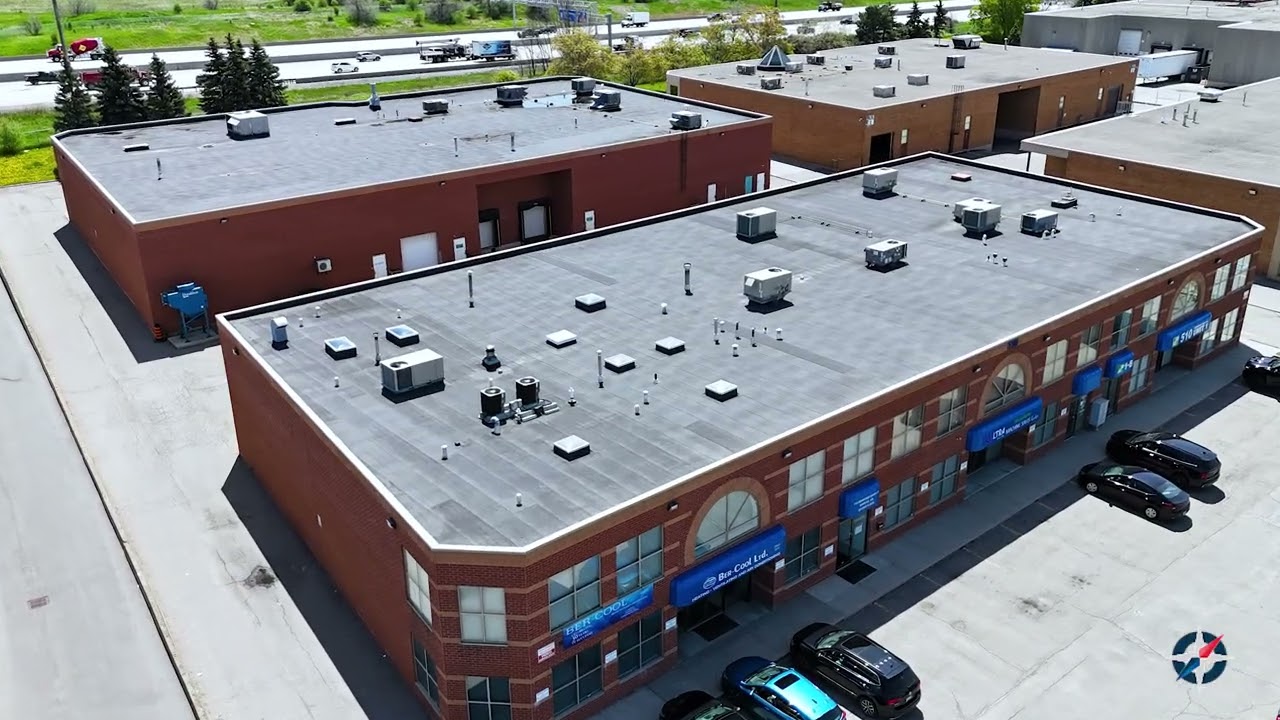
Burlington's employment land sits mainly north of the QEW, in the corridor running from Appleby and Harvester through the North Service Road area and up towards Mainway and Corporate Drive. The characteristic building is the flex or office-industrial unit: a low-rise structure with a finished office frontage of one or two storeys, a warehouse or light manufacturing area behind, and a single continuous flat roof over both.
Most of this stock dates from the 1980s through the 2000s. Roofs are steel deck on joists, with modified bitumen on the earlier buildings and mechanically attached single-ply on the later ones. Roof areas are moderate rather than vast, and the buildings are frequently subdivided into small tenancies, so a single roof may cover four or five occupiers.
The technical quirk of the flex format is the boundary. The office end is heated and humidified to comfort conditions; the warehouse end may be heated to a few degrees above freezing or barely at all. The roof assembly crosses that boundary continuously. Where the vapour retarder is discontinuous or the insulation thickness was never adjusted for the difference, condensation forms inside the assembly on the warm side, and owners report a leak on a day when it has not rained.
Why is freeze-thaw such a factor along the Burlington lakeshore?
Because Lake Ontario keeps the immediate lakeshore hovering near the freezing point instead of holding a steady deep freeze. The result is many more cycles across zero across a winter than an inland site sees. Every cycle expands water that has found its way into a lap, a crack in a coping joint or a masonry parapet, and every cycle opens that path a little further. Freeze-thaw damage is cumulative and it concentrates in the details rather than the field.
The visible outcomes on Burlington roofs are spalling and open joints in parapet masonry and coping, split base flashings at roof-to-wall junctions, ice building at scuppers and internal drains, and failure of sealant-dependent details that were never meant to be the primary barrier. The Ontario Building Code lists climatic design data for each municipality in Supplementary Standard SB-1, and Burlington's lakeshore values reflect its moderated position. The design implication is that detailing durability, not snow load, is the main climatic risk to a Burlington roof.

Commercial Roof Replacement in Smiths Falls, near Ottawa
Our Burlington service mix
Detail work and moisture diagnosis lead, with replacement following where the assembly has taken on water.
Flashing, coping and parapet rebuilds where freeze-thaw has opened the details.
Drain and scupper upgrades to move meltwater off before it refreezes.
Flat roof replacement with a properly continuous vapour retarder and insulation appropriate to each zone.
- Maintenance scheduled in autumn, before the cycling season begins.
Where an owner is planning capital works across several units, the flat roof cost calculator gives a defensible starting figure, and our commercial roofing page explains how we scope and phase the work.
What we do in Burlington
Commercial roofing
Commercial roofing for commercial and industrial buildings in Burlington.
Flat roof repairs
Flat roof repairs for commercial and industrial buildings in Burlington.
Emergency roof repairs
Emergency roof repairs for commercial and industrial buildings in Burlington.
Flat roof replacement
Flat roof replacement for commercial and industrial buildings in Burlington.
- Roof installation & replacement. Roof installation & replacement for commercial and industrial buildings in Burlington.
- Roof inspections. Roof inspections for commercial and industrial buildings in Burlington.

Roofing in Burlington: questions we get asked
Our Burlington unit shows drips on cold dry days. Is the roof leaking?
Probably not in the ordinary sense. Warm humid air from the office end of a flex building migrates into the assembly, condenses on cold steel deck or fasteners, and drips. Tell-tales are drips in cold clear weather rather than rain, and a pattern matching the fastener grid. The remedy is correcting the vapour retarder and insulation, not patching the membrane.
Why does freeze-thaw matter more here than further inland?
Because the lakeshore hovers around freezing rather than staying frozen, so Burlington sees many more crossings of zero in a winter. Each cycle expands water sitting in a coping joint, a lap or a masonry parapet and enlarges the path. The damage accumulates in details rather than in the open field, which is where we concentrate inspection and repair effort.
Do we need a Burlington permit to replace our commercial flat roof?
The City says all construction related to a building requires a permit except in specific listed cases, and its shingle exemption is written for pitched roofs. For a commercial flat roof, the deciding question is whether your scope includes structural work such as deck replacement, new openings or new rooftop equipment. Confirm your specific scope with Burlington's building department.
Can our four tenants stay in during a re-roof of a Burlington flex unit?
Generally yes. Roof areas here are moderate, so we can work in sections that are opened and closed within a shift. The two things to manage are odour and noise over the finished office end, which we schedule around meetings and tenant hours, and protection over any warehouse racking. Access is usually straightforward from the yard rather than needing a crane.