Commercial and Industrial Flat Roofing in Hamilton
A mill roof in the north end and a plaza roof in Ancaster are not the same trade, and Hamilton has both within a few kilometres.
NorthCan Roofing works on Hamilton's industrial and commercial flat roofs, including heavy industrial buildings in the harbour-side manufacturing belt. Chemical and fume exposure, harbour moisture and wind coming over the escarpment all shorten membrane life here, which changes both the material choice and the maintenance interval.
What is different about a Hamilton industrial roof?
Hamilton's north end and harbour lands hold the heaviest industrial building stock in the region: steelmaking and metal fabricating plants, foundries, and the supplier buildings around them, much of it long-span steel-framed with steel deck and, in the older sheds, corrugated metal roofing on purlins. Alongside that sits a large stock of mid-century commercial and institutional buildings on the mountain and along Main and King, and newer business park stock in Ancaster, Stoney Creek and along the Red Hill corridor.
The heavy industrial roofs are the ones that demand a different approach. They are large, often high, frequently penetrated by stacks, vents and process equipment, and their internal environment is hot and humid in ways that push moisture up into the roof assembly. Above them the exhaust from process equipment lands back on the roof surface. A membrane that would last a normal service life on a warehouse in Milton can degrade far faster on a mill roof that receives acidic or oily fallout day after day. On these buildings we look first at what the roof is being exposed to and only then at what to put on it.
How do the escarpment and the harbour load a roof here?
Hamilton's topography is unusual for southern Ontario. The Niagara Escarpment cuts across the city, separating the lower city from the mountain, and wind moving across that step behaves differently from wind over flat ground: it accelerates and separates at the brow, and buildings sited near the edge or in the reentrant valleys can see local wind effects that a flat-ground assumption misses. That matters for edge metal fastening and for anything mounted proud of the roof surface.
At the same time the lower city sits against Hamilton Harbour, which keeps humidity high and puts a marine-like moisture load on metal components: fasteners, deck, edge metal, screens and rooftop equipment corrode faster in the harbour lands than in an inland business park. Combine that with process fumes and you have a corrosive environment rather than merely a wet one. The Ontario Building Code publishes climatic design data by municipality in Supplementary Standard SB-1, including wind and snow values for Hamilton, and those feed the structural and uplift design. What the code does not describe is chemical exposure, which is why material selection on a mill roof has to be based on the actual process below.
What we do on Hamilton's industrial buildings
Membrane work, metal work and coatings, in roughly equal measure.
- Industrial roofing on plants, foundries and process buildings.
- Industrial roof coatings and restoration systems on metal and ageing membrane roofs where the substrate is sound but the surface is not.
- Metal roofing and cladding repair on older sheds, including fastener replacement and lap sealing.
- Chemically resistant membrane selection where process exhaust falls on the roof.
- Inspection and corrosion survey of deck, fasteners and edge metal in the harbour lands.
- Commercial flat roof repairs on the mountain and in Ancaster and Stoney Creek business parks.
Coating a roof is not a universal answer. It works where the substrate has structural integrity and the failure is at the surface or the laps; it is a waste of money over wet insulation or a corroding deck. We core and survey before we recommend it, and we will say so when replacement is the honest call. The flat roof cost calculator will frame a replacement budget for comparison.
Travelling to Hamilton from our Toronto yard
Hamilton is the furthest west we regularly work, and every crew reaches it from 425 Alness Street in Toronto by way of the QEW or Highway 403. We have no Hamilton yard, office or local number; the line for all Hamilton enquiries is 416-456-0777. Because of the distance we plan Hamilton work as continuous mobilisations with materials staged on site, and we are straightforward with clients that a single half-day visit is an inefficient way to use us here.
What that means in practice is that Hamilton clients get most value from planned work and from properly scoped repair visits rather than from a stream of small callouts. Genuine emergencies still go through the 24/7 line to emergency roof repairs. Our nearest other coverage is Burlington and Oakville, which lets us combine trips along the QEW corridor. The complete list is on the service areas page.
Hamilton's permit route for roof work
The City of Hamilton administers building permits through its Planning and Economic Development department, with a permits and inspections stream aimed at businesses as well as its main building permit pages, and an online permit portal. Start at the City's building permits for businesses information and confirm your scope with Hamilton's building division.
The Ontario-wide principle applies here as elsewhere: like-for-like roofing replacement without structural work is generally exempt, while structural alterations require a permit. On Hamilton's heavy industrial buildings the structural side is very often engaged, because deck and purlin corrosion is common in the harbour lands, and reinforcing or replacing structural steel is not optional once it is found. Expect engineered drawings on that scope. If your building is in one of Hamilton's designated heritage properties or districts, particularly around the downtown core, heritage approval may also apply to visible exterior changes. We set out our commercial approach on the commercial roofing page.
When is a coating the right answer instead of a new roof?
A liquid-applied coating or restoration system buys additional service life on a roof whose problem is surface degradation, open laps, or corroded but structurally sound metal. It is a real option on a Hamilton metal shed roof with sound purlins and rusted fastener heads, or on a single-ply roof that has weathered but is dry beneath.
It is the wrong answer when moisture scanning shows saturated insulation, when the deck has section loss, when the existing surface cannot be cleaned to a condition the coating can bond to, or when the process below is putting something on the roof that will attack the coating as readily as it attacked the membrane. In a fume-exposed environment the chemical compatibility of the coating with the actual exhaust matters more than its published weathering performance. We ask what the stacks are discharging before we specify, and where the answer is not known, we test.
Jobs we have filmed in Hamilton
Real NorthCan projects at named addresses in and around Hamilton.
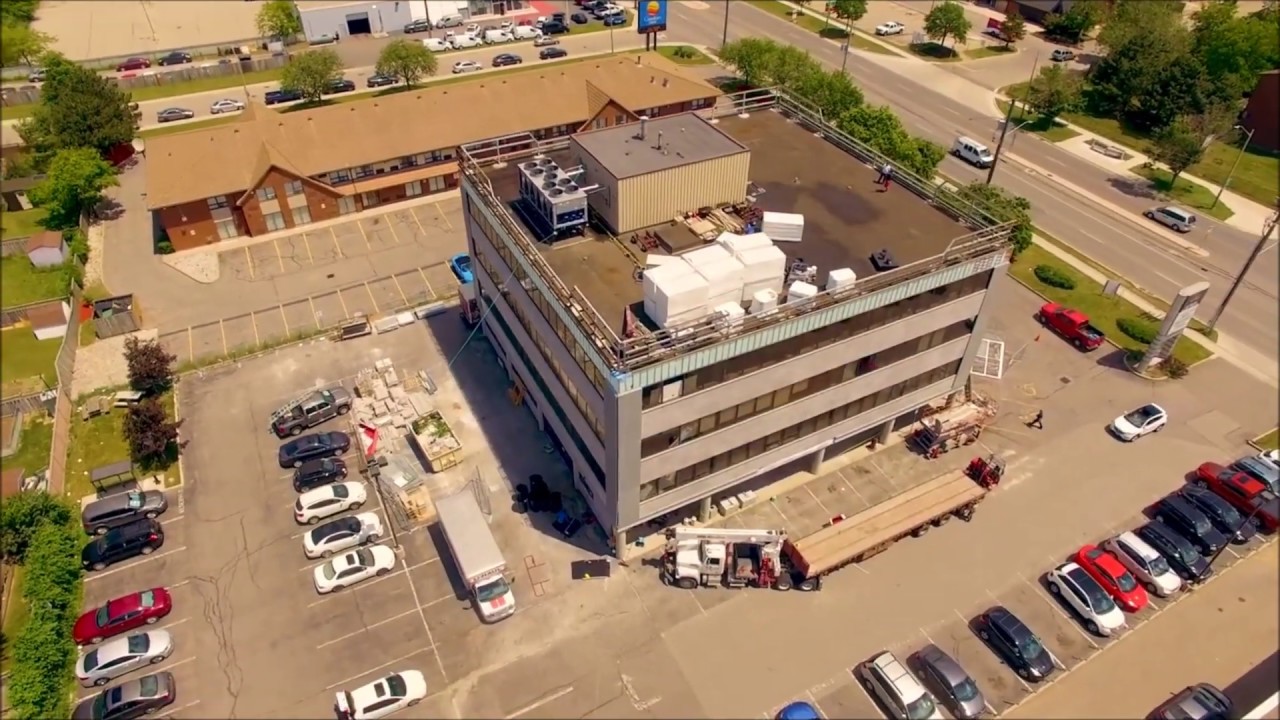
Commercial Flat Roof Replacement at 425 Rennie Street in Hamilton
What we do in Hamilton
Commercial roofing
Commercial roofing for commercial and industrial buildings in Hamilton.
Flat roof repairs
Flat roof repairs for commercial and industrial buildings in Hamilton.
Emergency roof repairs
Emergency roof repairs for commercial and industrial buildings in Hamilton.
Flat roof replacement
Flat roof replacement for commercial and industrial buildings in Hamilton.
Roof installation & replacement
Roof installation & replacement for commercial and industrial buildings in Hamilton.
Roof inspections
Roof inspections for commercial and industrial buildings in Hamilton.
Roofing in Hamilton — questions we get asked
Our plant's exhaust falls on the roof and eats the membrane. What can be done?
Specify for the exposure rather than for the weather. Some membrane chemistries tolerate oils, solvents or acidic fallout far better than others, so the first step is establishing what the stacks actually discharge and where it lands. Options include a chemically compatible membrane in the fallout zone, sacrificial walkway and protection layers, and relocating or extending discharge points where the process allows.
Does being near Hamilton Harbour really shorten roof life?
It shortens the life of the metal components in particular. Persistent high humidity in the harbour lands corrodes fasteners, edge metal, equipment curbs, screens and, over time, the deck itself. Membranes are less affected than steel is. That is why our Hamilton surveys include a corrosion assessment of the fastening and metal work rather than just a membrane condition report.
Do you work above the escarpment as well as in the lower city?
Yes. The stock on the mountain and in Ancaster and Stoney Creek is mostly commercial and business park rather than heavy industrial, so the work is closer to standard low-slope membrane replacement and repair. The escarpment matters technically because wind accelerates over the brow, which affects edge fastening on buildings sited near the edge.
Why do you insist on core cuts before quoting a coating in Hamilton?
Because a coating over wet insulation or a corroding deck is money spent to hide a problem that keeps growing underneath it. Cores tell us whether the insulation is dry and the deck sound. On harbour-side industrial buildings we also check purlins and deck for section loss. If the substrate fails those checks, we will recommend replacement and explain why rather than sell the cheaper option.
Free roof assessment in Hamilton
Tell us the address, the roof size and what you are seeing. We will book a time to get up there and put it in writing.
Call 416-456-0777 for anything urgent. Our emergency line is answered around the clock.
Call 416-456-0777