
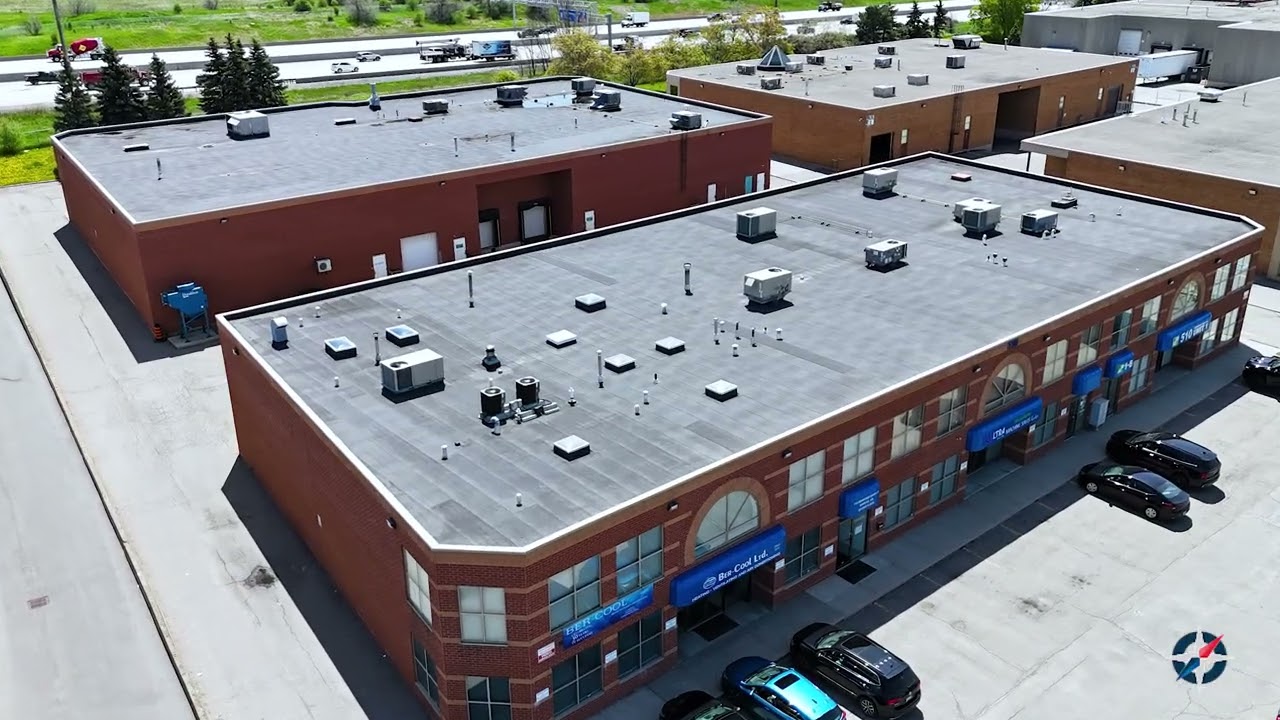
No single membrane wins in Ontario. SBS modified bitumen suits roofs with heavy foot traffic and dense rooftop equipment. TPO and PVC suit large open fields, with PVC where grease or chemical exhaust lands. EPDM stays flexible in deep cold. What actually decides service life is the detailing and the assembly beneath.
What does the Ontario climate demand from a flat roof?
Four mechanisms drive most of what we repair in this province, and any membrane worth specifying has to cope with all of them.
- Freeze-thaw cycling. Southern Ontario crosses zero repeatedly through the shoulder seasons. Water sitting in a lap or a hairline split expands as it freezes and widens the defect with every cycle. A membrane that goes brittle in the cold is at a disadvantage.
- Thermal movement. A dark roof surface swings through a wide temperature range in a single summer day and again across the seasons. The assembly has to absorb that movement at every termination and joint.
- Snow and ice. Design snow and rain loads come from the climatic data for each municipality in OBC Supplementary Standard SB-1, and drifting against parapets and mechanical screens concentrates load above the field value. Ice damming at the cold perimeter holds meltwater against base flashing.
- Standing water. Low slope plus slow melt means water sits. Every system on this list resists water. Not all of them tolerate being submerged for weeks.
Add to that the ordinary abuse of a commercial roof, mechanical contractors, hail, wind uplift at the perimeter, and grease or process exhaust on some buildings, and the shortlist narrows quickly.
Why is SBS modified bitumen the workhorse here?
Because it is redundant and it takes punishment. An SBS assembly is normally two plies, a base sheet and a granulated cap sheet, torch-applied, mopped or self-adhered. The styrene-butadiene-styrene modifier gives the bitumen elasticity that holds up in cold weather, and the second ply means there is no single line of defence.
Practical strengths on an Ontario commercial building: it tolerates foot traffic and rooftop equipment better than a thin single ply, the granulated cap protects the bitumen from ultraviolet exposure, repairs are straightforward because a compatible patch can be torched or self-adhered onto the existing cap sheet, and site-built details at curbs, corners and drains are easy to form in a material that can be worked around a shape.
The trade-offs are real too. Torch work means hot work, a fire watch and care on a building with combustible elements, which is why self-adhered and cold-applied variants exist. It is a heavier assembly than a single ply, and it is slower to install over a very large open field. Our post explaining SBS modified bitumen roofing covers the assembly in detail.
Where does TPO earn its place?
On large, open, lightly trafficked fields. TPO is a single-ply thermoplastic sheet, heat-welded at the seams, and a welded seam is a genuinely strong joint when it is done properly and probed afterwards. Sheets come wide, so a warehouse or distribution roof goes down quickly with relatively few seams.
Where TPO gets into trouble is where the roof is busy. A single ply is one layer, so a puncture from a dropped tool or a dragged conduit is a hole through the system rather than through the first of two plies. That is manageable with walkway pads on the routes to rooftop units and a maintenance routine that catches damage, but it has to be planned rather than assumed.
Welding quality also matters more than with a redundant assembly. Cold-weather welding needs the equipment set correctly and the seam checked, and a weld that looked fine and was never probed is a defect waiting for a freeze-thaw season.
What is EPDM good at?
Cold and movement. EPDM is a synthetic rubber sheet, seamed with tape or adhesive rather than heat, and it stays flexible at low temperatures. It handles thermal movement well and it has a long track record on Ontario buildings, both mechanically fastened and in ballasted assemblies.
Its weak point is the seam, because it is bonded rather than welded and it depends on correct surface preparation and primer. Seams are the first thing we probe on an aged EPDM roof. Black EPDM also runs hot in the summer sun, and repairs need the right primer and tape rather than whatever will stick.
Where EPDM appears in a ballasted assembly, the stone holds the sheet down and shields it from ultraviolet exposure, but it also hides the membrane from inspection. That trade-off is covered in our post on why flat roofs have gravel.
When is PVC the right specification?
When the roof surface is going to be exposed to grease, animal fats or chemical exhaust. Restaurant kitchen exhaust zones, food processing plants and some manufacturing sites destroy membranes that are not formulated for it, and PVC is the standard answer. Like TPO it is heat-welded, so it shares the strong-seam advantage and the single-layer vulnerability to puncture.
The other reason PVC gets specified is where a manufacturer's detailing for a difficult condition is well established, for example around dense penetration clusters. It is generally a more expensive sheet than TPO, so it is chosen for a reason rather than by default.
Is built-up roofing still worth considering?
It is still on a great many Toronto buildings and it is still repairable, which matters more than whether it would be specified new. A built-up roof is multiple bitumen-saturated plies with a gravel or cap-sheet surfacing, and its redundancy is the reason so many of them have lasted.
What makes them difficult is inspection and repair. Under gravel you cannot see the membrane, so finding an opening means clearing stone and probing, and a patch on a gravel-surfaced roof only works if the surface is properly cleared and prepared first. Where a BUR assembly is dry and the deck is sound, it can often be repaired or recovered rather than removed. Where the insulation has gone wet across the field, it comes off.
Low-slope and standing-seam metal sit outside this comparison and are covered on our commercial metal roofing page, since they shed water rather than waterproofing a flat plane.
Does what sits under the membrane matter more than the membrane?
Frequently, yes. The sheet on top gets all the attention and it is rarely the reason a roof fails early.
The air and vapour control layer stops warm humid interior air reaching the cold insulation, which is critical in Ontario and doubly so in a building with process moisture. Insulation type, thickness and layer arrangement, with staggered joints, set the thermal performance required under the Ontario Building Code. Tapered insulation and crickets create the drainage path, and drainage is the single largest determinant of how long a low-slope roof lasts. A cover board protects the membrane from hail, foot traffic and fastener back-out.
Attachment matters as much: mechanically fastened, adhered or ballasted, selected against the wind uplift demand for the building height and roof zone, with increased fastener density at perimeters and corners. On a re-roof, the holding capacity of the existing deck is checked before the pattern is set. Get any of that wrong and a well-chosen membrane will still fail early.
How do you match a system to a building?
Work through the building rather than the brochure. What is the deck, and what will it hold? How much rooftop equipment is there, and how often will someone walk to it? What does the building exhaust? What is the interior humidity load? Is the drainage sound, or does it need rebuilding as part of the project? Is hot work acceptable on this site? Who will maintain the roof, and how often?
Those answers usually pick the system on their own. A busy plant roof crowded with units points to a two-ply SBS assembly. A new distribution building with a vast open field points to a heat-welded single ply. A kitchen exhaust zone points to PVC. A full side-by-side comparison lives in our guide to flat roof types and systems, and the range of assemblies we install is on the commercial roofing page. To have the building assessed rather than guessed at, call 416-456-0777.