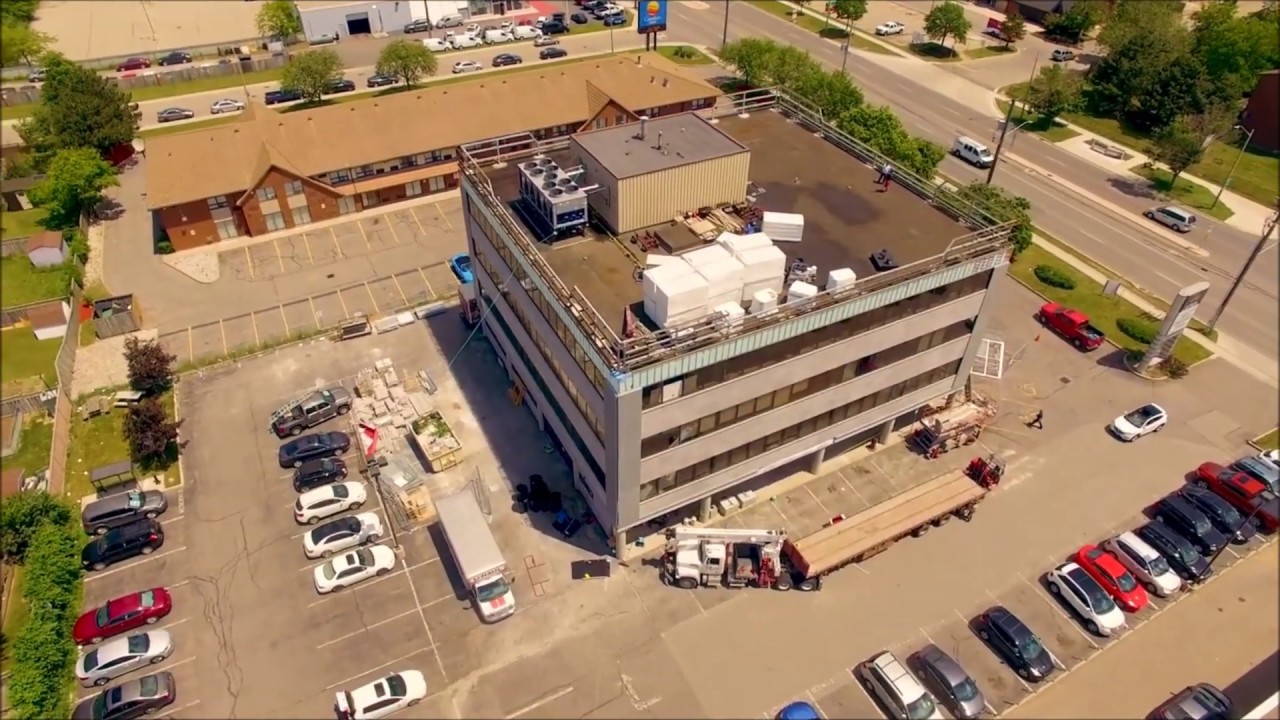
Area. A distribution centre roof can be several hectares.
Logistics, staging, material handling and daily watertight stopping points matter more than crew speed.
Large-area flat roofing on operating industrial sites across Toronto, the GTA and southwestern Ontario.
Everything that is a detail on a small building becomes a system on a large one.
Logistics, staging, material handling and daily watertight stopping points matter more than crew speed.
Long-span steel joists and deep steel deck deflect more than a concrete deck, which changes fastener selection, insulation layout and where ponding develops.
Dozens of units, make-up air, dust collectors, process exhaust, refrigerant lines, gas piping and conduit runs, each of which is a penetration and a potential leak.
Grease, oils, solvents and chemical discharge land on the membrane downwind of the stack, and membrane chemistry has to suit that exposure.
Scale also changes how a roof is owned. Nobody walks a five-hectare roof casually, so problems go unseen for far longer than on a small commercial building, and the first symptom is often water on the floor rather than a defect on the roof. That is why large sites benefit most from a mapped roof plan with numbered areas and a documented inspection history, so a condition is tracked rather than discovered.
Wind does not load a roof evenly. Pressure is highest at the corners, next highest along the perimeter, and lowest in the field, and the difference is large. That is why the fastening pattern is not uniform across an industrial roof.
We assume the plant runs. That assumption shapes the plan before anyone is on the roof.
The same phasing discipline applies to a full roof replacement on an occupied building.
Communication is the part that most often fails on an industrial site, so we fix it before mobilising: one named foreman, one named contact on your side, a short daily note of what area is being worked and what is planned for the following day, and immediate notification if anything is found that affects the plant below. On multi-shift sites that note goes to the shift supervisors as well, because the crew arriving at seven in the morning did not hear yesterday's conversation.
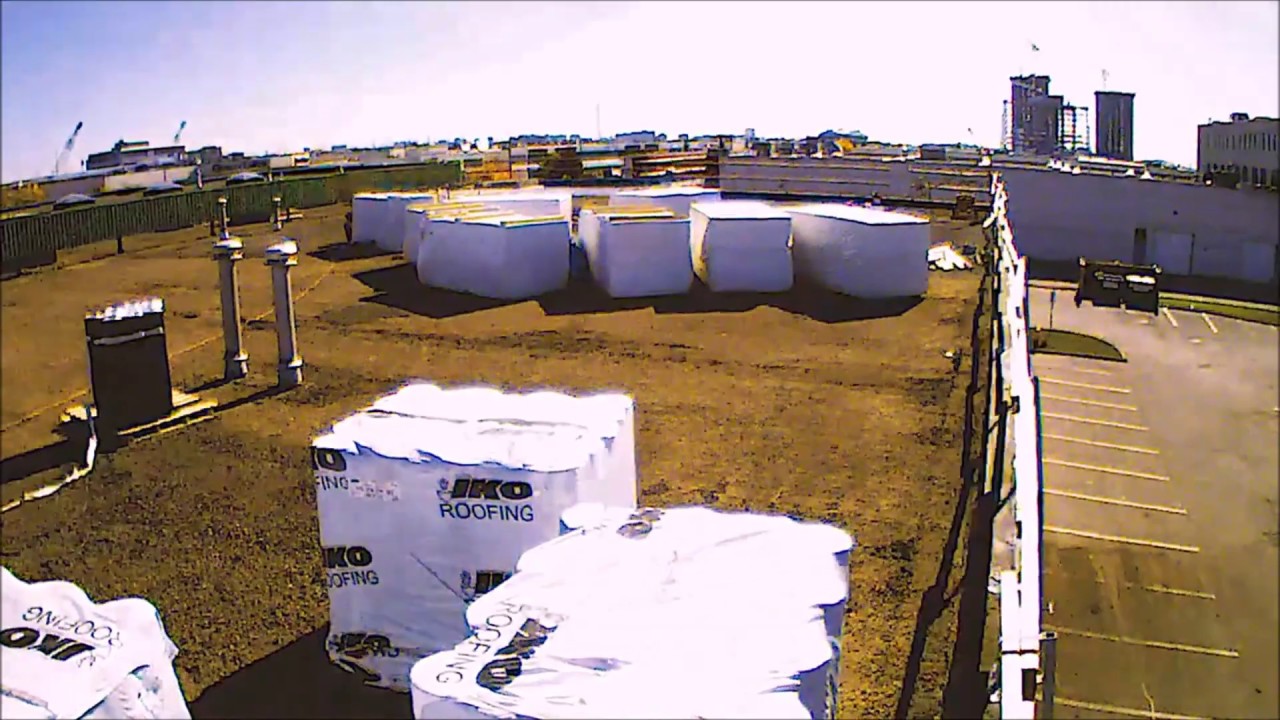
Woodbridge Flat Roof Repair at 120 Jevlan Drive
Industrial roofs are worked on constantly, by us and by your own trades, which makes access and edge protection a permanent facility issue rather than a project one.
Our crews work under the Occupational Health and Safety Act and the Ministry of Labour, Immigration, Training and Skills Development working-at-heights requirements: guardrails or travel restraint at every open edge, fall-arrest where restraint is not practical, anchor points selected for the deck type and capacity, controlled access zones around openings and skylights, and a written rescue plan on site. Crews complete the site orientation your plant requires and work to your permit systems.
We also report on the permanent provisions during any inspection: the condition of hatches, fixed ladders and stairs, whether existing anchor points are documented and inspected, whether skylights are guarded or screened, and whether service routes to rooftop units have walkway protection. Unguarded skylights are the hazard most often missed on an industrial roof, and they are covered on commercial skylight installation.
Where your own staff and companies regularly access the roof, documented anchor points and a clear designated walking route are worth having in place before the next trade arrives rather than after an incident.
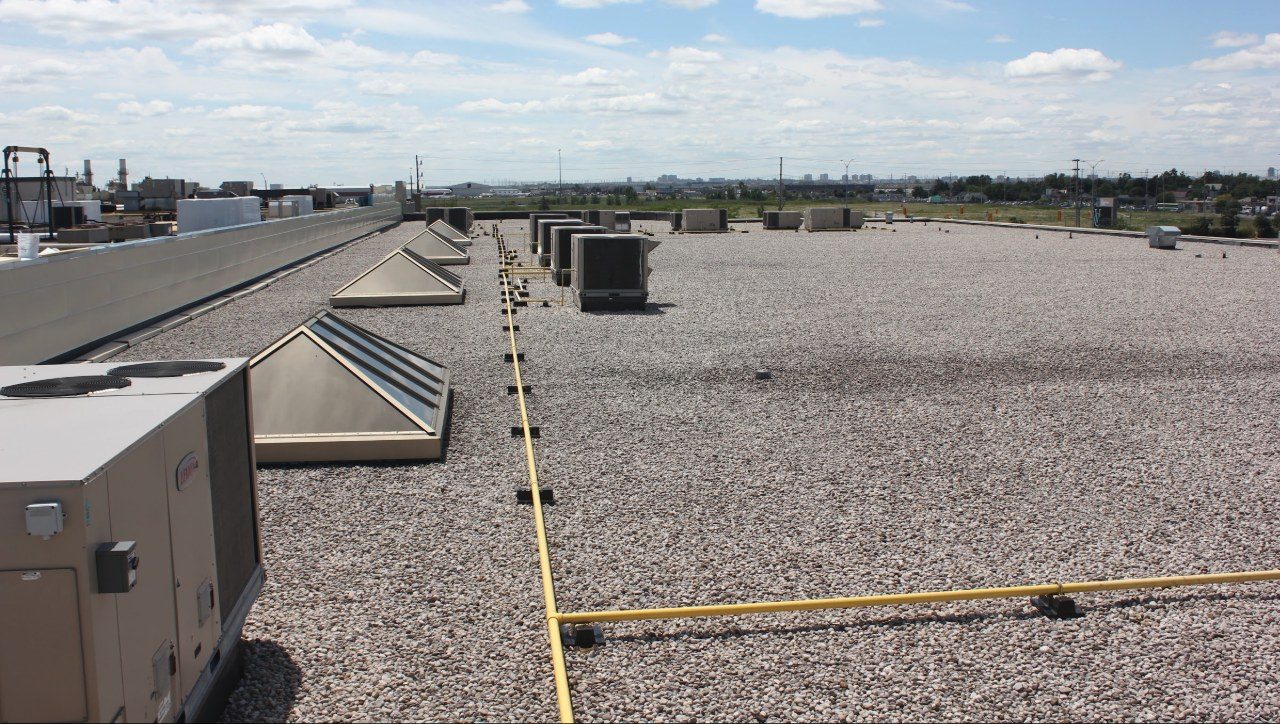
Industrial flat roof field
In nearly all cases yes. The roof is phased area by area against what sits underneath, hot work is controlled or eliminated by specifying self-adhered or mechanically fastened assemblies, intakes are protected, and no deck is left open overnight. The areas over sensitive processes are scheduled around your downtime.
Call 416-456-0777 for an emergency attendance to dry the area in and clear any blocked drainage, then move product out from under the affected bay. Once the make-safe is done, we survey the assembly to find whether it is a detail failure or wet insulation, which decides between a repair and a phased replacement.
Yes. Grease, animal fats, oils and some solvent exhausts degrade certain membranes and their seams, typically in a plume downwind of the stack. PVC is normally specified for those zones. Where exhaust is a known issue we also detail the surrounding area for cleaning access and check it at every maintenance visit.
Commercially that is between you and that company, but practically it becomes your leak. We document any third-party damage found during maintenance visits with photographs and location, which gives you what you need to raise it, and we quote the repair separately.
Sometimes, and it needs checking first. Added load, new penetrations, altered drainage patterns and the effect on an existing manufacturer warranty all matter. Structural capacity is a professional engineer's call. We assess the roof assembly, detail the supports and penetrations properly, and advise whether it is wiser to schedule the addition with a re-roof.