
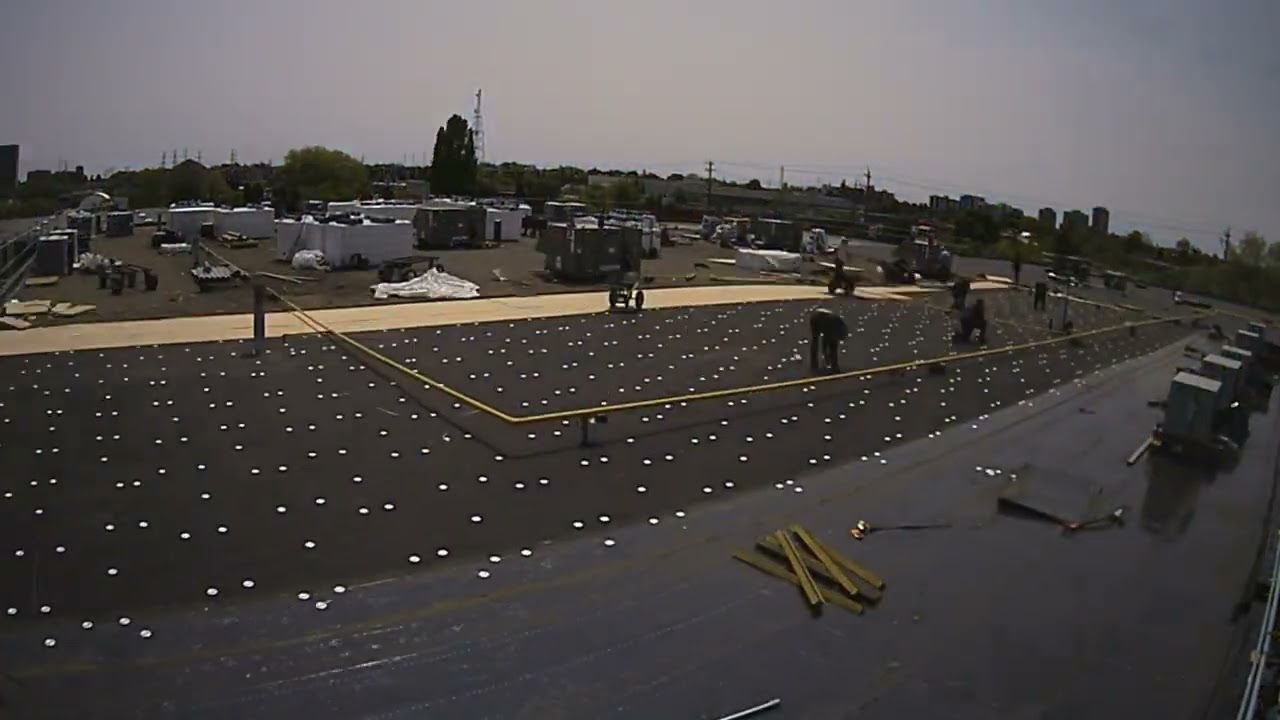
Repeat leaks become a replacement decision when the evidence shows the failure is general rather than local. Wet insulation across a large share of the field, splits in unrelated areas, fasteners backing out, lost surfacing and a corroding deck all point one way. A single detail failing repeatedly is still a repair, provided the surrounding assembly is dry.
What counts as a recurring leak rather than a new one?
Building owners often describe three separate leaks when they actually have one. Water that enters the roof assembly does not fall straight down. It travels between the membrane and the insulation, along the top of the vapour barrier, across the flutes of a steel deck or along a beam, until it reaches an opening: a deck seam, a fastener, a conduit penetration, a light fixture. On a steel deck the flutes act as channels and can carry water many metres before it drops.
So a stain over the shipping office in October and a drip over the lunchroom in March can be the same entry point behaving differently as the roof loads and unloads with water and snow. Before deciding a roof is failing generally, the interior evidence has to be mapped back to the roof properly, which is the diagnostic work described in our piece on the three main causes of flat roof leaks.
A genuine recurrence is a leak that returns to the same interior location after a repair was made at the correct entry point and the wet material was removed. That is the pattern that should trigger a wider look at the assembly rather than another patch.
Why does a leak come back after a proper repair?
There are three common reasons, and they are worth separating because only one of them means the roof is finished.
The wet insulation was left in place
This is the most frequent cause of a returning leak, and it is a scope failure rather than a roof failure. A repair that seals the membrane but leaves saturated insulation underneath will keep the ceiling damp for months. The water has nowhere to go, the insulation loses compressive strength, and the area compresses into a new low spot that ponds and reopens the detail. A defensible repair cuts back to dry material, replaces the insulation and cover board, and ties the new membrane into the surrounding field.
The entry point was never the one that was repaired
Water travelling laterally makes this easy to get wrong. Patching directly above the stain is the classic mistake. If the actual opening is a cracked corner at a curb eight metres away, the patch will hold perfectly and the leak will continue.
The assembly no longer holds a repair
This is the one that signals replacement. When bitumen has lost its oils across the field, when a single-ply sheet has shrunk and is pulling at every fixed termination, or when the insulation is broadly wet, a new patch introduces a stiff, well-adhered area into a sheet that is moving. The membrane then splits at the edge of the repair. Repairs failing at their own perimeters, repeatedly, is a strong indicator.
What site evidence points to replacement?
These are the findings that move a roof across the line toward flat roof replacement, and none of them can be judged from the ground.
- Widespread wet insulation. Established by moisture survey and confirmed with test cuts. When a large share of the field reads wet, cutting it out piecemeal costs more than replacing it and leaves a patchwork of different assembly heights.
- Splits in unrelated areas. Not one lap, but openings appearing in the field, at corners and over deck joints in places with no common cause other than the age and condition of the sheet.
- Fasteners backing out. Visible bumps in a mechanically fastened membrane where plates have worked up through wet, compressed insulation. This also means the wind uplift resistance the roof was designed for is no longer there.
- Deck deterioration. Corrosion on a steel deck under the wet areas, or spalling and delamination on a concrete deck. Any structural concern goes to a professional engineer, not to a roofer.
- Repairs in the same areas season after season. The pattern in your own invoice file is evidence in its own right.
What evidence says keep repairing?
Plenty of roofs that leak repeatedly are still good candidates for repair, and replacing them early wastes capital.
The picture that supports continued repair looks like this: moisture readings come back dry outside a defined area; the membrane in the field is still flexible and holds its surfacing; the failures are concentrated at details rather than in the sheet, which usually means flashing at curbs, pitch pockets, drains or the perimeter; and previous repairs are still holding where they were made.
Detail failures are extremely common on roofs that are otherwise sound, because details carry the most movement and the most site-built work. A roof can be leaking in five places every spring and still be a repair roof, if all five are curbs and pitch pockets and the field around them is dry. Rebuilding those details properly, rather than resealing them, often buys years. Our approach to that work is set out under flat roof repairs and in the comparison of temporary and permanent repair solutions.
What are the risks of continuing to repair a roof that is finished?
The roof itself is rarely the expensive part of this decision. The consequences below it are.
Interior and inventory damage. Water reaching racked stock, production equipment, electrical panels or tenant finishes generates costs that dwarf the roofing scope, and it generates them repeatedly.
Deck deterioration. Wet insulation held against a steel deck corrodes it. What starts as a roofing project becomes a structural one, with an engineer, a longer schedule and deck replacement in the scope.
Escalating scope. Every year of delay expands the wet area, which expands the tear-off, the disposal and the deck work in the eventual replacement. The project does not get cheaper by waiting.
Operational disruption. An emergency failure in February is handled on the weather's schedule, not yours. A planned replacement is phased, sequenced around your operation and priced with time to compare. A planned replacement is phased and sequenced around your operation.
How does the Toronto climate affect the timing?
Southern Ontario compresses the timeline in two ways.
Freeze-thaw cycling is the first. Water sitting in a seam, a lap or a hairline split expands as it freezes and opens the defect a little further with every cycle. Toronto crosses zero repeatedly through November and again through March, so a small opening in the autumn is a larger one by April. A roof that is marginal in October is measurably worse in May.
Snow and ice loading is the second. The Ontario Building Code sets ground snow load and rain load by municipality in Supplementary Standard SB-1, and drifting against parapets, mechanical screens and adjacent higher walls concentrates that load well above the field value. Wet insulation adds weight of its own, and it does so exactly where the assembly has already lost strength.
Ice damming at the parapet completes the picture. Meltwater runs to the cold perimeter, refreezes at the parapet and around the drains, and backs up behind the ice until it finds the base flashing. That is why so many Toronto buildings report their worst leaks during a thaw rather than during rain. More on that pattern is in how severe Toronto weather affects commercial roofs.
Practically, this means the decision is most usefully made in spring or early summer, with the work scheduled for the same season. Deciding in December means either an emergency dry-in or another winter of the same leaks.
How should the decision be documented?
An owner, a board or a head office should not be asked to approve a capital project on the strength of a verbal opinion. The document that supports the decision contains, at minimum:
- The roof areas identified and measured, with a plan showing each.
- The assembly confirmed by test cut, layer by layer, at representative locations.
- A moisture survey showing the extent and distribution of wet insulation.
- Deficiencies listed by priority with dated photographs.
- Remaining service life for each roof area, and the reasoning behind it.
- The repair option and the replacement option, each with what it does and does not resolve.
That is what a flat roof inspection and condition report produces, and it is the thing that converts an argument into a schedule.
If you are managing a building in Toronto or the GTA where the same leak keeps returning, call 416-456-0777 or use the contact page and we will start from the interior evidence and work back to the roof.