
Assembly design with a continuous vapour control layer and insulation sized for the interior conditions.
Commercial and Industrial Flat Roofing in Kitchener, Waterloo and Cambridge
Kitchener's converted brick factories are the hardest roofs in Waterloo Region: old masonry, new tenants, and a roof that has to do both jobs.
What is on the roofs of Waterloo Region's commercial buildings?
Three overlapping stocks. The oldest and most distinctive is the brick industrial heritage of downtown Kitchener: former furniture, rubber, tannery and textile buildings along the rail corridor and around Victoria and Charles streets, many now converted to office and technology use. These buildings have heavy timber or early steel structures, thick load-bearing masonry, tall parapets and multi-level roofs with skylights, monitors and light wells that were cut for daylight in an era before electric lighting was cheap.
Second, the working manufacturing and distribution stock spread through Kitchener's industrial areas and out into Cambridge, from mid-century plants with built-up roofs to modern single-ply warehouses. Cambridge in particular retains substantial heavy manufacturing.
Third, the technology and office development of the last two decades in Waterloo and along the Kitchener-Waterloo corridor, with newer flat roofs, roof terraces and dense mechanical plant.
The conversions are the technically hardest. A brick industrial building that used to be a lightly heated factory is now a humidified office full of people and computers, and the roof assembly it was given decades ago was never designed for that internal environment.
Why do converted brick industrial roofs behave badly?
Because the conversion changed the building physics and often not the roof. Raise the interior temperature and humidity, and moisture drives upward into an assembly that may have no vapour retarder at all, condensing on cold surfaces and wetting insulation. Thick masonry parapets that used to be uniformly cold now have a warm inner face, which changes where freezing happens within the wall. The Ontario Building Code lists climatic design data by municipality in Supplementary Standard SB-1, and Waterloo Region's inland position gives it colder winter design temperatures than the Toronto lakeshore, which sharpens all of this.
Then there is the geometry. These buildings rarely have one simple flat roof. They have multiple levels from successive additions, saw-tooth or monitor sections, original skylights and light wells, valleys between bays, and internal drainage running through the building. Every change of level and every skylight kerb is a detail that can fail, and there are a great many of them per square metre compared with a modern warehouse. Add masonry parapets whose copings and joints have taken a century of frost, and the roof edge becomes as much of a project as the field.
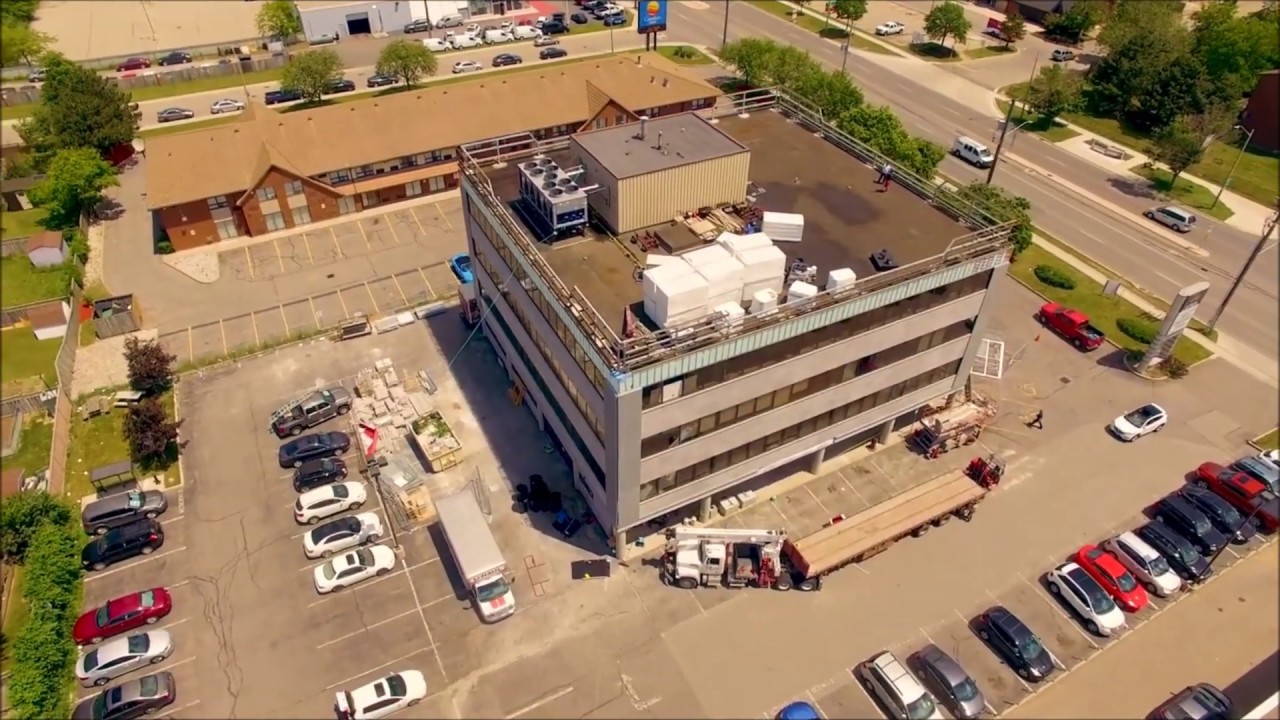
Flat Roof Repair in Hamilton by NorthCan Flat Roofing Inc.
What we do differently on a conversion roof
We start with the interior environment, not the membrane. Before specifying anything on a converted Kitchener building we want to know what the space is used for, how it is heated and humidified, whether there is a vapour retarder in the existing assembly, and where the current cold surfaces are. Without that, a new membrane can make a condensation problem worse by sealing the assembly more tightly.
Skylight, monitor and light well detailing that keeps daylight without keeping the leaks.
Parapet and coping rebuilds coordinated with masonry restoration where the wall itself is failing.
Multi-level tie-ins and valley detailing on buildings assembled from successive additions.
- Phasing around occupied tenancies, with access frequently limited to a narrow lane or a small yard.
For budget planning start with the flat roof cost calculator, but be aware that on a heritage conversion the detail count, not the area, drives the number. Our scope is described on the commercial roofing page.
What we do in Kitchener
Commercial roofing
Commercial roofing for commercial and industrial buildings in Kitchener.
Flat roof repairs
Flat roof repairs for commercial and industrial buildings in Kitchener.
Emergency roof repairs
Emergency roof repairs for commercial and industrial buildings in Kitchener.
Flat roof replacement
Flat roof replacement for commercial and industrial buildings in Kitchener.
- Roof installation & replacement. Roof installation & replacement for commercial and industrial buildings in Kitchener.
- Roof inspections. Roof inspections for commercial and industrial buildings in Kitchener.
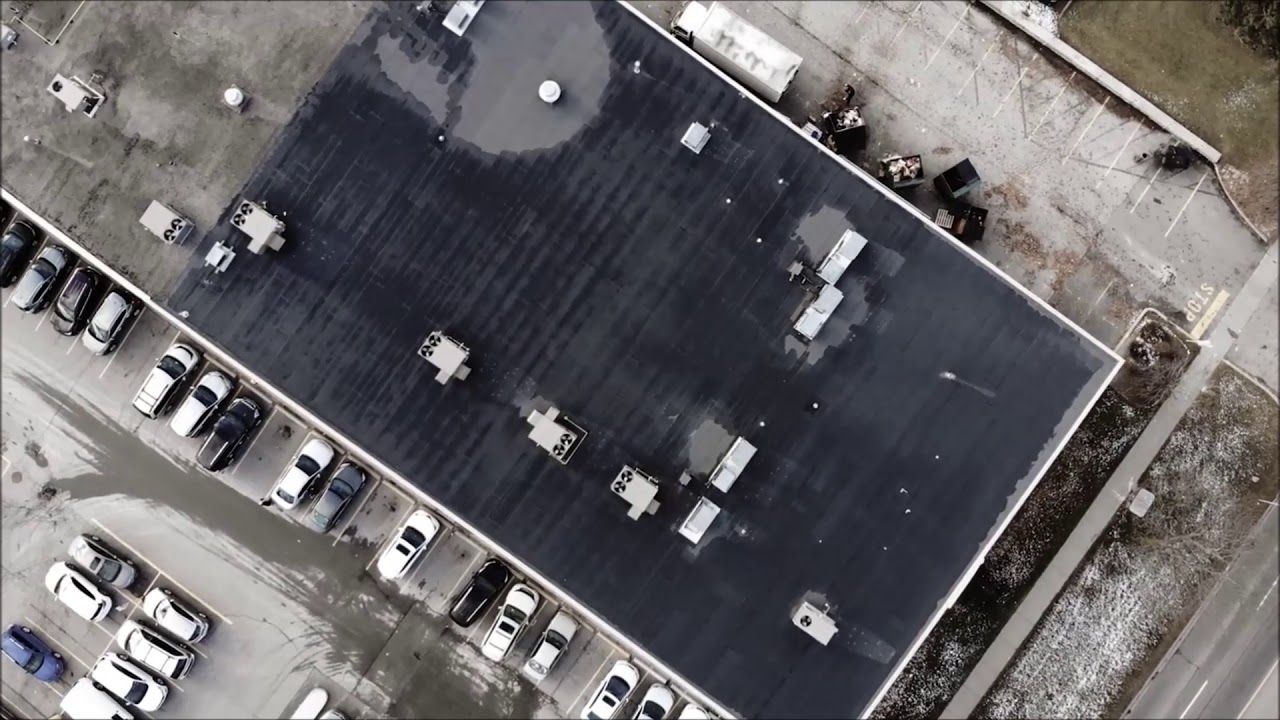


Roofing in Kitchener: questions we get asked
Do you cover Waterloo and Cambridge from this page?
Yes. Kitchener is our anchor for Waterloo Region and we work in Waterloo and Cambridge on the same basis, with crews travelling from Toronto. Each city has its own building department, so a permit application goes to the municipality your building is in. Cambridge work leans more towards heavy manufacturing, Waterloo more towards technology and institutional buildings.
Our converted factory office has damp ceilings but the roof looks sound. What is happening?
Very likely condensation rather than leakage. Conversion raised the interior temperature and humidity, and the roof assembly probably has little or no vapour control. Moisture migrates upward, condenses on cold surfaces inside the assembly and wets the insulation. Diagnosing it means examining the whole assembly and the interior conditions, and the remedy is assembly design rather than a patch.
Does adding insulation to our Kitchener roof need a permit?
Kitchener's published list includes re-insulating walls, ceilings or floors among the work that requires a building permit, while installing new shingles on an existing roof does not. Since upgrading insulation is often central to fixing a converted building's roof, plan for an application. Confirm the current position and your specific scope with Kitchener's building division before scheduling.
Can the original skylights and roof monitors be kept on a heritage industrial building?
Usually, and often they should be, both for daylight and because they may form part of what a heritage designation protects. They do have to be re-detailed properly: new kerbs, correct upstand heights, and flashing that does not depend on sealant. Establish the heritage status first, because replacing a monitor with a modern unit may need approval even if it performs better.