
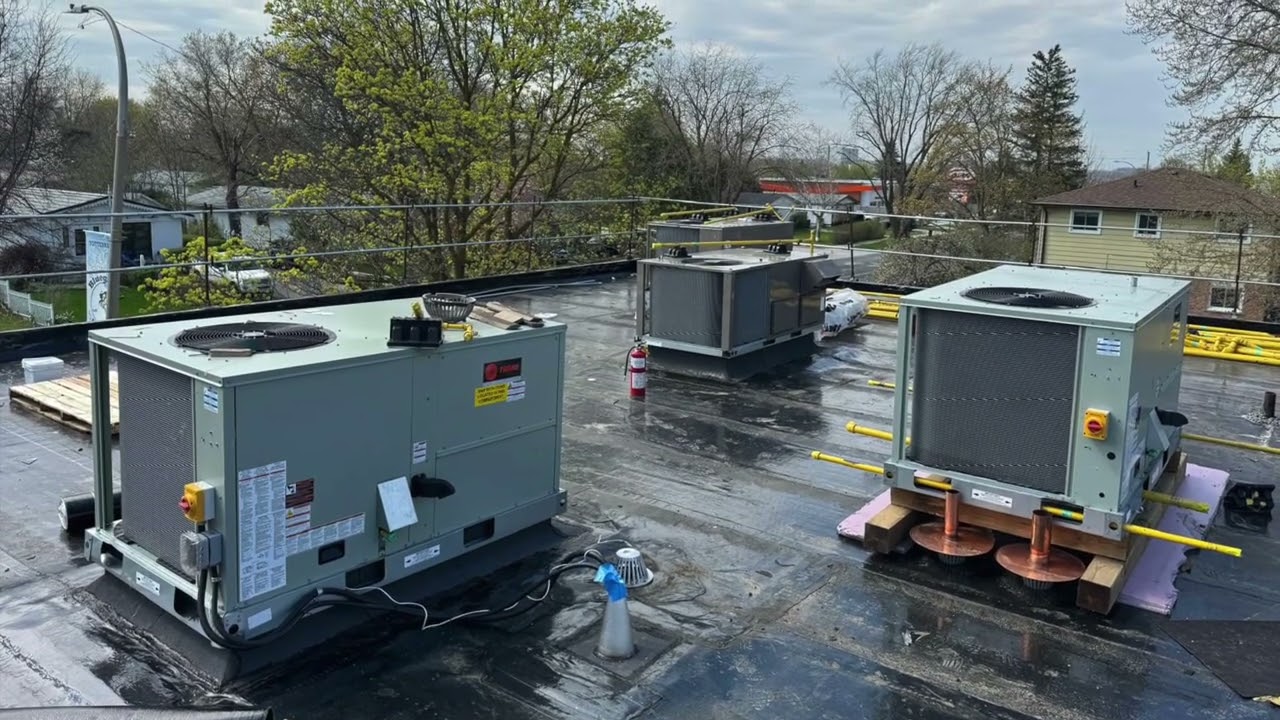
Storm work on a Barrie commercial roof runs in three stages. Contain the water inside the building first, because interior loss moves faster than roof loss. Then stabilise the roof with a temporary repair once it is safe to be up there. Then scope and complete the permanent rebuild when conditions allow.
What makes Barrie harder on a flat roof than Toronto?
Two things, and both are geography rather than construction quality.
Snow. Barrie sits at the south end of Kempenfelt Bay in a band that takes lake effect snow off Georgian Bay. Supplementary Standard SB-1 of the Ontario Building Code lists ground snow load and rain load by municipality, and the values listed for Barrie are higher than those listed for Toronto. That is not a detail for the structural engineer alone. More snow on the roof means more meltwater during a thaw, more drift loading against parapets and mechanical screens, and more ice forming at the cold perimeter and around drains.
Exposure. Much of the newer commercial and industrial stock along the Highway 400 corridor and in the north end business parks sits on open ground with little shelter. Open exposure raises wind uplift demand at the roof perimeter and corners, and it drives snow into drifts against every vertical obstruction on the roof.
Barrie roofs fail at the same details as Toronto roofs, parapets, curbs and drains, but they get there through heavier snow and ice cycling. The local picture is on our Barrie commercial roofing page.
What counts as a roofing emergency?
Anything where water is entering the building now, or where the roof has been physically opened and the next weather event will put water in. In practice, the calls that come in after a Simcoe County storm are:
- Wind damage at the perimeter. A length of cap flashing or parapet metal lifted, or a section of loosely attached membrane peeled back at a corner. Perimeter and corner zones carry the highest uplift pressures on the roof, which is why they go first.
- Ice backing up at drains and parapets. Meltwater runs to a cold edge, refreezes, and backs up behind the ice until it goes over the base flashing.
- Ponding after a heavy rain on a blocked drain. Sudden load plus water sitting over a defect it would otherwise shed.
- Impact damage. Wind-borne debris, a fallen branch, or something that has come off a neighbouring roof and punctured a membrane.
- Hail bruising on an aging membrane or on rooftop unit cabinets.
- Deflection or unusual noise under heavy snow. Not a roofer call: evacuate and call a structural engineer.
A stain on a ceiling tile with no active drip is not an emergency, but it is a diagnostic job that should not wait for the next storm. Full detail is on the emergency roof repair page.
What should a Barrie building do in the first hour?
Everything in the first hour is inside the building. Stay off the roof.
- Move what can be moved. Stock, files, product, electronics. Cover what cannot be moved with poly.
- Control the water. A drum with a hose, or a bag taped to a small controlled penetration in the ceiling, is better than buckets, because it decides where the water goes instead of letting it spread across a suspended ceiling.
- Isolate electrical. Have an electrician take down circuits, fixtures or panels the water is reaching. Do not have staff working under a live fixture that is dripping.
- Photograph and time-stamp. The interior, the containment, the weather. The insurance file starts here, and so does the roofer's diagnosis.
- Note the pattern. Is it leaking only during driving rain from one direction, only during a thaw, or continuously after any rain? Each points at a different cause.
- Call it in. 416-456-0777. Our emergency line is answered around the clock.
Keep people off the roof during and after a storm. Snow hides skylights, hatches and open edges, and a snow-covered commercial roof is one of the more dangerous places on a property. Working at heights in Ontario is regulated under the Occupational Health and Safety Act, with training and fall protection requirements enforced by the Ministry of Labour, Immigration, Training and Skills Development. It is not a job for building staff with a ladder.
What does the crew do when it gets on the roof?
The first task is not repair, it is assessment and access safety. Edge protection or travel restraint goes in before anyone works near an open edge, and on a snow-covered roof the crew locates skylights, hatches and drains before walking freely.
Then the sequence runs:
- Find the entry point. Work back from what is happening inside. Check what sits directly above the affected area, identify the deck type, then check the nearest transitions, curbs, drains and penetrations.
- Clear the water path. Open blocked drains and scuppers. On a Barrie winter call this alone is often what stops the leak, because meltwater with nowhere to go finds the weakest detail.
- Remove snow and ice from the work area only. Carefully, with tools that do not gouge the membrane, and never with metal shovels or ice chippers on the sheet.
- Dry in the opening. A mechanically fastened patch, a reinforced mastic repair over a split, or a self-adhered patch where the surface can be dried and warmed. The choice depends on the temperature and the substrate.
- Secure loose metal. Refasten or remove lifted cap flashing so the next wind event does not take it into the parking lot.
- Record everything. Photographs of every defect and every repair, with a written description for your insurer and for the permanent scope.
What the crew is doing is buying a controlled amount of time under bad conditions. The trade-offs between that and a finished detail are set out in our post on temporary and permanent flat roof repairs.
Why does the permanent repair have to wait?
Because a permanent detail installed into a wet, frozen assembly fails again, and then you have paid twice.
Rigid insulation that has been soaked does not dry inside a sealed roof. It has to come out. Cutting it out means opening the roof, which on a January day in Simcoe County means exposing a deck to weather with a short and unreliable working window. Adhesives and sealants have minimum application temperatures. Torch-applied work needs a clean, dry substrate and a fire watch. Single-ply seams need dry, clean membrane to weld properly.
So the honest scope after a storm is usually: stabilise now, map the damage now, and rebuild when the roof can be opened and closed in the same day. The mapping matters, because the extent of wet insulation determines whether the spring work is a localised flat roof repair or something larger. Moisture scanning or targeted test cuts turn that from an argument into a drawing.
What does the storm reveal about the rest of the roof?
Storms are diagnostic. They test every detail on the roof at once, and they fail the weakest ones. When we attend an emergency in Barrie we look beyond the immediate leak for the things that are about to become the next call.
- Fastener pattern at the perimeter. If a corner lifted, the question is whether the attachment density in the corner zone was ever adequate for the building's exposure, or whether fasteners have backed out over time.
- Drain and scupper capacity. Whether there are overflows at all. An overflow scupper is what stops a blocked primary drain from turning a rainstorm into a structural load problem.
- Drift zones. Where snow piles against parapets, mechanical screens and step-ups to higher walls. Those are the areas that stay under ice longest and where base flashing gets worked hardest.
- Cap flashing condition along the whole run. If one lap opened, the rest are the same age and exposure.
- Curb detailing under rooftop units. Especially where mechanical trades have cut flashing for new conduit.
Those findings belong in a written document rather than a verbal handover, which is what a roof condition report is for. It is also the thing that lets a Barrie owner put the roof into a capital plan rather than discovering it during the next storm.
How do you stop being the building that always calls in a storm?
Two seasonal checks do most of the work, and neither is expensive relative to one interior water event.
Before the fall rain. Clear drains, scuppers and overflows of leaves and debris. Check that drain sumps still sit below the surrounding insulation. Walk the perimeter for open cap flashing laps, backed-out fasteners and split corners. Check pitch pockets and reseal any that have dished.
Before the spring melt. Clear drains again, check for ice damage at the parapet, look at base flashing where drifts sat, and inspect anywhere a temporary repair was placed over the winter.
On a Barrie building, add a third item: a snow management plan agreed before winter. That means knowing who decides when snow comes off, who does it, what tools are permitted on the membrane, and where the snow goes. Uncontrolled snow removal by a general contractor with metal shovels does more membrane damage than the snow would have.
All of this sits inside a scheduled flat roof maintenance programme. If you want the roof looked at before the season turns, call 416-456-0777 or book a walk through the contact page.