
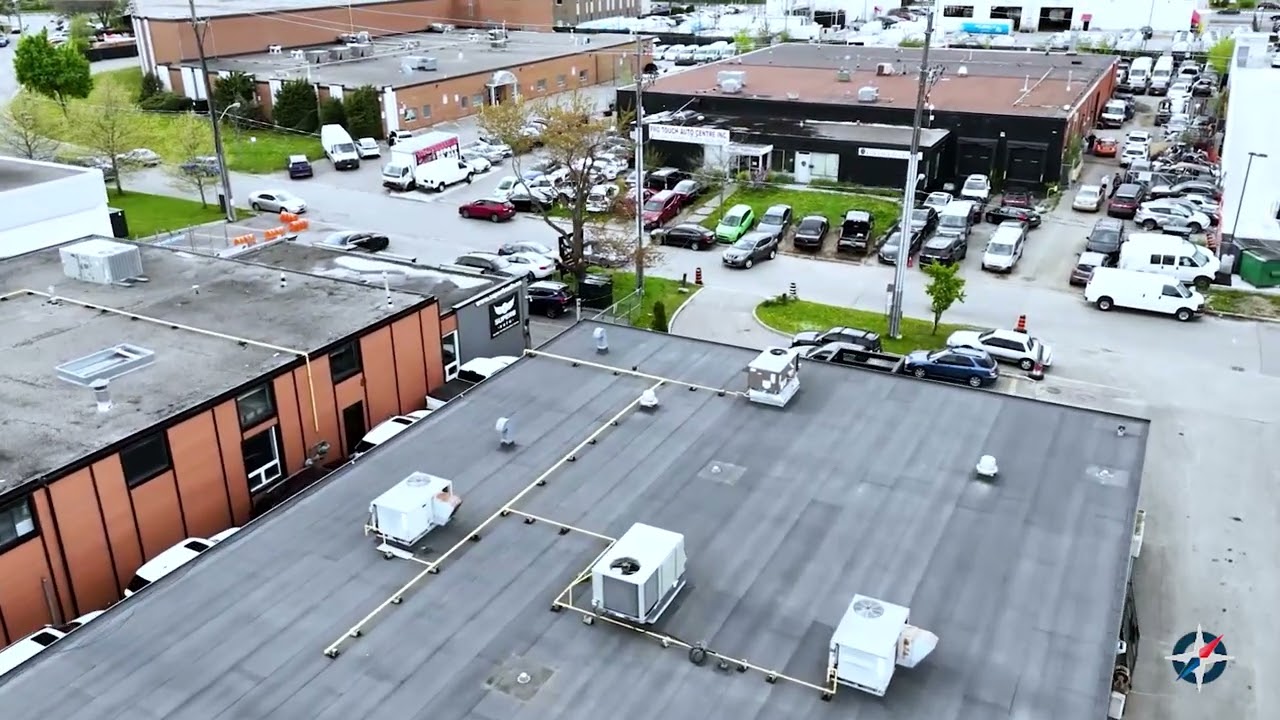
An emergency roof call runs in three stages. First the building is protected inside, because interior damage usually outruns roof damage. Then the entry point is found on the roof and the water is cut off with a temporary dry-in. Only afterwards, once the assembly is dry and the cause is confirmed, is the permanent repair scoped and built.
What counts as a roofing emergency on a commercial building?
Active water entering an occupied or stocked building is an emergency. So is a condition that will become one within hours: membrane lifted or peeled back by wind, cap flashing missing along a run of parapet, a drain leader that has failed inside the building, a skylight or hatch damaged by impact, or standing water building against a blocked drain with rain still falling.
A ceiling stain with no active drip is usually not a same-night emergency, but it is not nothing either. It means water has been in the assembly long enough to travel and to soak through, and the insulation above it is almost certainly wet. That gets a scheduled visit rather than a night call, and it gets one before the next freeze, not next season.
The distinction matters because emergency work is stabilisation, not repair. It buys the building time under conditions that make proper work impossible. Everything we do on an emergency roof repair call is chosen so that it does not have to be undone when the permanent scope is built.
Hour one: what should the building do before anyone arrives?
The first hour belongs to the people inside, and it is worth more than anything the roofer does that night. In a Toronto office tower, a Scarborough warehouse or a plant floor, the priorities are the same.
- Move stock, files, product and electronics out from under the drip, and sheet over what cannot be moved. Racked inventory and server rooms first.
- Control the water rather than chasing it. A small controlled penetration in a ceiling tile grid with a hose or bag into a drum concentrates the flow into one place instead of letting it spread across the ceiling plenum.
- Have an electrician isolate any circuit, fixture or panel the water is reaching. Water and live equipment is the part of a roof leak that actually hurts people.
- Photograph everything with a time stamp, including the weather and the exterior, for the insurance file.
- Note the pattern. Continuous after any rain, only in wind-driven rain from one direction, or only during a thaw. Each points somewhere different.
Keep people off the roof during the event. A wet membrane, a snow-covered skylight and poor visibility at the parapet edge make a commercial roof genuinely dangerous, and what a staff member can learn up there rarely justifies it.
What happens when the crew reaches the roof?
Diagnosis starts inside, not outside. We look at what sits directly above the stain, what the deck is, and where the nearest transitions and penetrations are. On a steel deck the flutes carry water horizontally, sometimes many metres, before it drops through a fastener hole or a deck seam, which is why the wet ceiling tile is a starting point rather than an answer.
On the roof the search follows a short list, because leaks cluster. Base flashing at the parapet, cap flashing laps and the reglet, curbs under rooftop units, pitch pockets that have shrunk away from the pipe they seal, drain clamping rings and target flashings, expansion joints, and open laps in the field. In winter we add the ice conditions: meltwater running to a cold perimeter, refreezing at the parapet and backing up behind ice until it finds the base flashing.
Where the leak is not obvious we probe outward from the suspected point to find how far the insulation is wet, and on larger roofs a moisture survey maps it properly. The membrane opening is often small. The wet area around it rarely is.
What does a temporary dry-in actually consist of?
It depends on the failure and on what the weather will allow, but the intent is always the same: stop water entering, and do it without creating a detail that has to be demolished later.
- Clear the drain first if water has nowhere to go. On a blocked roof, no patch holds against standing water, and the load is a separate concern.
- Cut back and dry the immediate area as far as conditions allow, then close it with a compatible patch: a torch or self-adhered SBS patch on a modified bitumen roof, a heat-welded patch on TPO or PVC, a taped or adhered patch on EPDM.
- Mechanically fastened membrane and a termination bar where the surface is too wet or too cold to bond reliably. It is not elegant, but it holds.
- Re-secure lifted metal at the roof edge or parapet cap so wind does not take more of it overnight.
- Seal at a defined edge, never a smear of mastic across a field of gravel or a wet membrane. Mastic over water traps the water.
A tarp is a last resort on a commercial roof. Tarps lift in wind, block drains and add load when they fill, and on a large field they rarely make contact where it matters. A dry-in that is mechanically held down is safer and lasts longer. Our post on temporary and permanent repair solutions compares the two in more detail.
Why does the permanent repair have to wait?
Because a permanent detail installed into a wet assembly fails again. Adhesives and torch-applied membrane need a dry, sound substrate. Wet insulation does not dry inside a sealed roof, so it has to come out, and the cut has to extend past the leak until probing or moisture readings come back dry.
That is why the permanent scope is usually larger than the emergency patch, and larger again than the hole. The membrane opening might be the width of a hand. The saturated insulation around it can run several metres, especially on a steel deck where the flutes distributed the water. Cutting back only to the visible damage leaves wet board under new membrane, which corrodes fasteners and the deck below and keeps the ceiling damp long after the roof has been closed.
The permanent work also fixes the cause rather than the symptom. If the base flashing failed because there was no cant strip and the membrane was terminated too low on the parapet, the repair rebuilds the detail properly. Details on how we scope that are on the flat roof repairs page.
How does winter change an emergency call in Toronto?
Considerably. Between November and April a Toronto roof crosses freezing repeatedly, and the failure mechanisms shift. Water that entered a lap in October freezes and widens it. Meltwater from a warm interior runs under the snow to the cold parapet and refreezes into a dam. Drains freeze solid while the field of the roof is still melting, so the roof holds water it cannot release.
Practically, that means snow has to be cleared from the work area before anything can be seen, and cleared carefully, with plastic tools and a layer left behind rather than a metal blade on the membrane. Adhesives behave differently in the cold and membranes are stiffer to handle, so mechanically fastened temporary work is often the right answer until conditions improve. Ice at the parapet is removed by melting or by hand, never by chipping through to the membrane.
Our piece on how severe Toronto weather affects commercial roofs goes through the seasonal mechanisms in full.
What should you have ready when you call?
The call goes faster with a few things to hand: the building address and the closest roof access point, whether access is through a hatch, an interior stair or an exterior ladder, who can let a crew in after hours, where the water is appearing inside and how fast, whether there is power near it, and whether anyone has already been on the roof.
If you hold a roof plan, previous roofing invoices, or a record of where past leaks appeared, have them ready. A leak history often points to the failing detail before the crew is on the ladder. Sites across the city and the wider region are covered from our shop at 425 Alness Street, and our commercial roofing in Toronto page lists the areas served. The emergency line is 416-456-0777, answered around the clock.