
Flat Roof Repairs for Commercial Buildings
Leak tracing, seam and flashing repair and wet insulation removal on low-slope roofs across Toronto and southwestern Ontario.
A flat roof repair is worth doing when the field of the roof is dry and the failures are local: split seams, lifted cap flashing, failed pitch pockets, cracked base flashing at curbs, or a drain that has pulled away from the membrane. NorthCan Roofing traces the leak, cuts out any wet insulation and rebuilds the detail. Call 416-456-0777.
Repair or replace: how do you decide?
The honest answer comes from four questions, in this order.
- Is the insulation wet, and how far has it spread? Water travels sideways between the membrane and the deck, so the wet area is almost always larger than the stain on the ceiling. A moisture survey maps it. Isolated wet zones are cut out and replaced during a repair. Moisture across the field means the assembly is finished.
- Is the failure at a detail or in the field? Details are repairable by definition. Field failures, meaning the membrane surface itself has lost its granules, crazed, blistered widely or shrunk away from its terminations, are a system condition, not a repair item.
- How many times has this area been repaired already? A third repair in the same location usually means the cause was never addressed. Often that cause is drainage.
- Is the deck sound? Corroded steel flutes or rotten wood under the leak change the conversation from repair to flat roof replacement.
Two clear yes answers on the first two questions and repair is the right spend. If you want that judgement documented for an owner or a capital plan, order a roof condition report instead of a repair quote.
Where do flat roofs actually fail?
After years of GTA service calls the same short list accounts for most water entry.
- Base flashing at parapets and walls. The membrane turn-up cracks at the cant strip or slips down the wall. Ice damming at the cold parapet drives water behind it. This is the most common leak source on a Toronto flat roof.
- Cap flashing and counter-flashing. Loose, unsealed or missing metal at the head of the parapet lets water in behind an otherwise perfect membrane.
- Roof drains. A clamping ring that has loosened, a drain flashing that has torn, a sump that has never been re-formed, or a strainer full of leaves and gravel. Standing water then freezes and works the joint open.
- Scuppers. Unlined or corroded scupper boxes at the parapet, and the wall below them staining as a result.
- Penetrations. Pitch pockets that have shrunk and cracked, gas line supports set directly on the membrane, conduit and refrigerant lines with no proper flashing, and antenna and satellite mounts installed by someone who was not a roofer.
- Rooftop equipment curbs. HVAC units where the curb flashing has torn, the unit rail sits low, or a condensate line discharges onto the membrane and keeps a strip permanently wet.
- Seams and laps. Cold-weld seams in single-ply and unbonded laps in modified bitumen, especially where a previous crew stopped and started.
- Ponding water. Not a leak in itself, but the accelerant behind most of the above through freeze-thaw cycling.
What happens on a repair visit?
A repair call runs as a defined sequence rather than a look and a bucket of sealant.
- Interior first. We start where the water shows, note the location relative to the structural grid, and work out where the entry point most likely sits on the roof, which is rarely directly above.
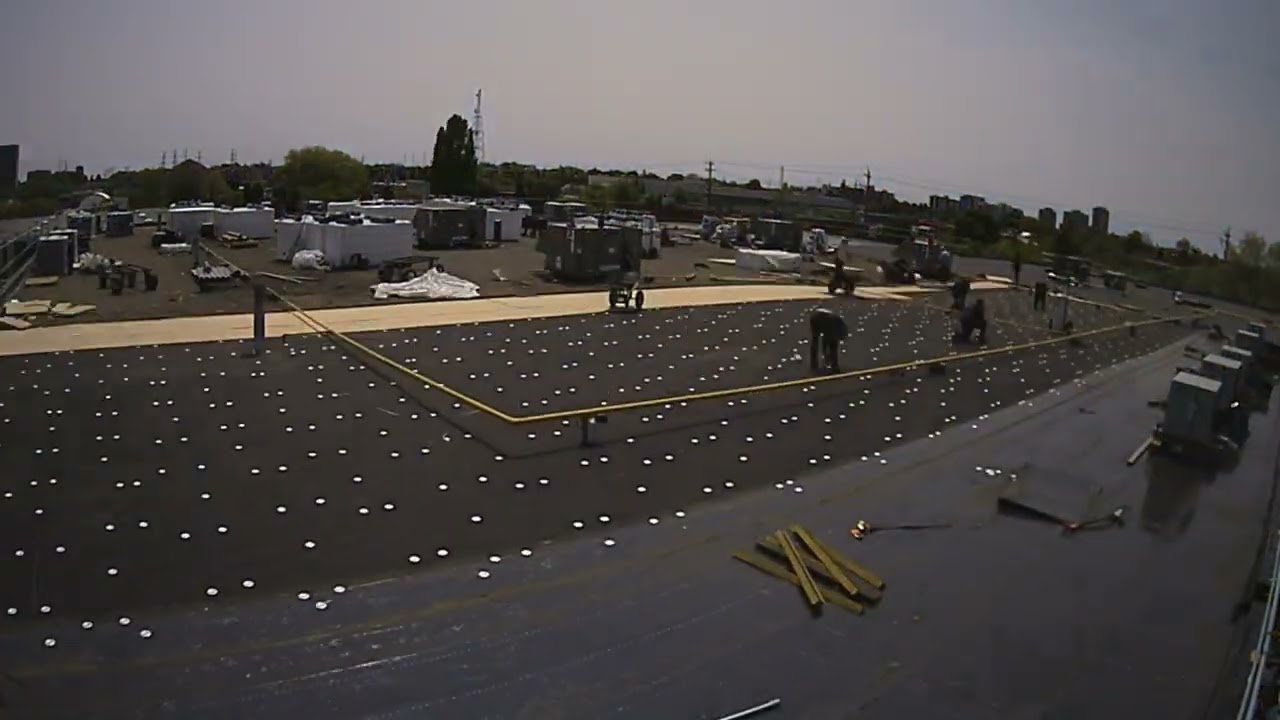
- Roof survey. Drains, details, penetrations, seams and the field are walked and photographed. Suspect areas are probed and, where needed, opened with a test cut so we can see every layer.
- Moisture check. Where the extent is unclear, an infrared or capacitance survey maps the wet insulation so the cut-out area is drawn rather than guessed.
- Make safe. If water is still entering, the area is dried in on the spot. That is a temporary measure and we say so.
- Repair. Wet insulation is removed to dry material, new insulation and cover board installed flush, and the membrane rebuilt in matching material with properly lapped and welded or torched plies. Metal details are re-formed and refastened, not caulked.
- Report. Before and after photographs, what was found, what was done and what we recommend next. That document goes to your file and, when relevant, to your insurer.
If the water is coming in right now, go to emergency roof repairs and call 416-456-0777 first.
Do you repair every system?
We repair the systems we install, which covers effectively every low-slope assembly on GTA commercial buildings: SBS modified bitumen, built-up roofing with gravel or cap-sheet surfacing, TPO, PVC, EPDM, and low-slope metal. Repairs are always made in compatible material. A single-ply membrane is welded or seamed with its own chemistry; asphalt-based products and thermoplastic membranes do not bond to each other, and a patch made with the wrong material is a leak with a delay built in.
Where the original membrane is discontinued or no longer available in a matching formulation, we say so and detail the transition properly rather than pretending the patch is like for like. System characteristics are compared on flat roof types.
How do you stop the same leak coming back?
Repeat leaks almost always have a cause upstream of the patch. The three we correct most often are drainage, movement and traffic.
- Drainage. If water ponds over the repaired detail, the repair is on borrowed time. The fix is a re-formed drain sump, a new drain, a scupper, or tapered insulation and crickets to move water off the flat spot. That is a small construction project, not a service call, but it ends the cycle.
- Movement. Details that are rigidly fastened across a moving joint tear again. Expansion joints and relieved terminations solve that; more sealant does not.
- Traffic. Service technicians walking the same route to the same rooftop unit will wear through any membrane. Walkway pads on the traffic route, and a proper equipment support rather than a block on the membrane, remove the cause.
Scheduled attention keeps the list short. Our commercial roof maintenance program includes spring and fall drain clearing and a documented seam and flashing check, which is what turns emergency repairs into planned ones. Buildings with heavy rooftop plant should also read industrial roofing.
One more cause worth naming is other trades. Mechanical, electrical, telecom and window cleaning contractors work on your roof and rarely leave it as they found it: a new penetration sealed with mastic, a conduit run laid on the membrane, a unit curb opened and closed badly. Requiring that anyone working on the roof reports it to you, and having those areas checked afterwards, prevents a surprising share of the leaks we attend.
What does a repair cost, and how is it quoted?
Repairs are quoted after the site attendance, in writing, with the scope described by detail rather than as a lump sum with no explanation. Where the extent of wet insulation cannot be confirmed until the membrane is open, the quote carries a unit rate for cut-out and replacement so the price follows the area actually found. Investigation work, moisture surveys and access equipment are listed separately so you can see what you are buying.
A workmanship warranty on the repaired area is issued in writing with the work. To sanity-check a budget before you commit, use the flat roof cost calculator, which gives a planning range for larger scopes. For anything else, call 416-456-0777 or use the contact page and we will book the assessment. Background on our full commercial service is on commercial roofing in Toronto.
Frequently asked questions
Why is the leak nowhere near the wet spot on the ceiling?
Because water runs between the membrane and the deck, and on a steel deck it follows the flutes until it reaches a fastener, a seam or a joint and drops through. Entry points are commonly several metres from the interior stain. That is why we survey the roof properly rather than patching the area directly above the damage.
Can a flat roof be repaired in winter?
Yes, with limits. Cold-weather repairs on modified bitumen and single-ply membranes are routine when the surface is clean, dry and free of snow and frost, and adhesives are selected for the temperature. Some adhered work and some coatings need warmer conditions. Where we cannot make a permanent repair safely, we dry the area in and return when conditions allow.
Do you repair roofs you did not install?
Yes. Most of our repair work is on roofs installed by others. We match the existing membrane chemistry, and if the assembly is unknown we take a test cut first so the repair is made into a known build-up rather than into a guess.
Will a roof coating fix my leaks?
Not on its own. A coating over a wet assembly seals the moisture in and can accelerate deterioration of the insulation and deck. Coatings and restoration systems have a real place on a sound, dry, structurally intact roof as a way of extending service life, and we will tell you plainly which of the two situations you have.
How quickly can you attend a repair?
Non-urgent repairs are scheduled against our current workload and the weather window, and we give you a date rather than a vague promise. Active water entry is handled through the emergency line at 416-456-0777 and is prioritised over scheduled work.
Does a repair affect the manufacturer warranty on my roof?
It can. Manufacturer system warranties normally require repairs to be made with approved components and often by a contractor recognised under that programme. Tell us the manufacturer and warranty reference before the work and we will detail the repair so it does not compromise the coverage you already hold.
Ready for your free roof assessment?
Tell us the address, the roof size and what you are seeing. We will book a time to get up there and put it in writing.
Call 416-456-0777 for anything urgent. Our emergency line is answered around the clock.
Call 416-456-0777