
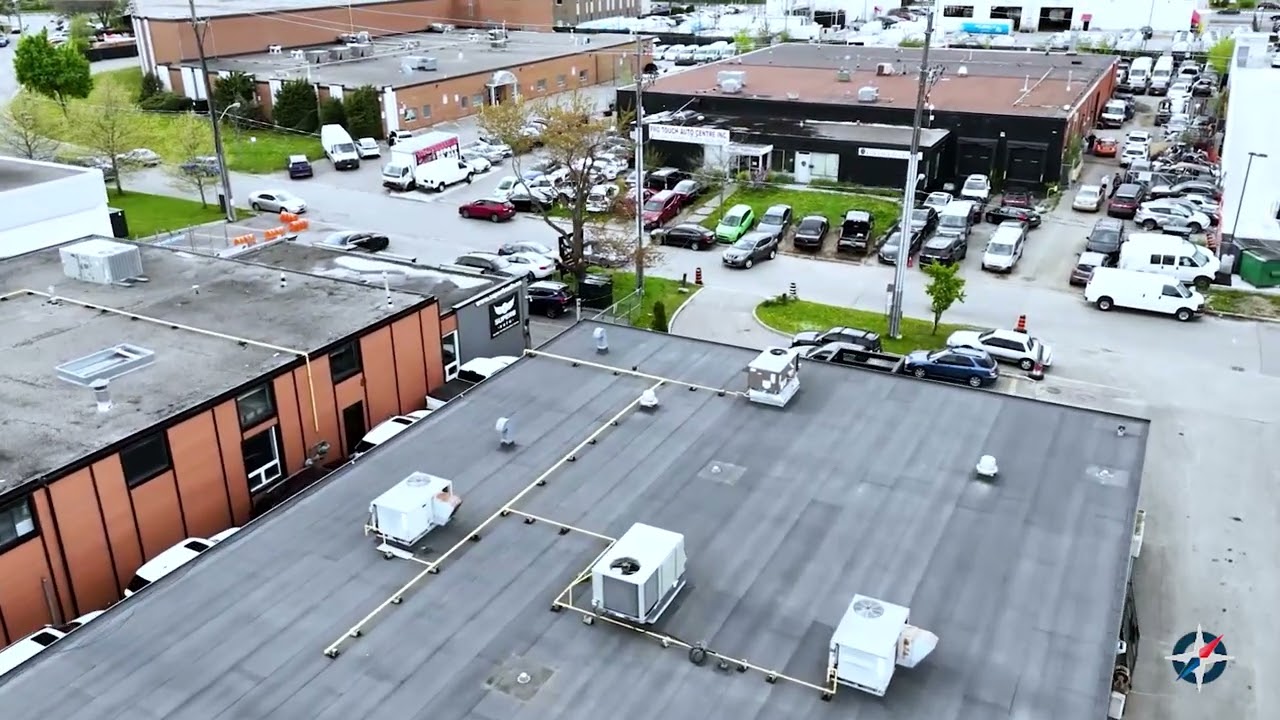
Restoration suits a roof whose deck and insulation are dry and whose membrane has aged at the surface rather than failed structurally. It is not an option where insulation is wet, where the deck is deteriorating, or where the membrane is splitting across the field. Core cuts and a moisture survey settle it.
What does restoration actually mean on a commercial roof?
Restoration is a family of interventions that renew the waterproofing surface and the details of an existing assembly rather than removing and rebuilding it. On commercial and industrial low-slope roofs in Ontario that usually means one of three approaches.
- A fluid-applied coating system. Cleaning and preparing the existing membrane, treating seams and details with reinforcing fabric, then applying a monolithic coating across the field. Applicable to modified bitumen, built-up, some single-ply and metal roofs, with different primers and compatibility rules for each.
- A cap sheet overlay. On a modified bitumen or built-up roof, installing a new cap sheet over the prepared existing surface. This renews the surfacing and gives a new wearing ply without touching the insulation.
- A comprehensive detail rebuild. Stripping and rebuilding every flashing, curb, drain and penetration to current standards while leaving a sound field alone. On many roofs this is the intervention that actually stops the leaks, because the field was never the problem.
What none of them do is change what is under the membrane. That is the whole test, and everything below follows from it.
What has to be true before restoration is on the table?
Five conditions. If any one fails, restoration is the wrong answer and no amount of product will change that.
- The insulation is dry. Coating over wet insulation seals moisture inside a closed assembly, where it keeps corroding fasteners and the deck and cannot escape. This is the single most common way a restoration goes wrong.
- The deck is sound. No corrosion on a steel deck, no spalling or deterioration on concrete, no rot on a wood deck. Deck condition is an engineer's call, not a roofer's.
- The membrane is intact, not split. Surface weathering, granule loss, chalking and general fatigue are restoration candidates. Splits appearing in unrelated areas across the field are end-of-life indicators.
- Drainage works. A coating applied to a roof that ponds is a coating that sits under water. Most coating systems are not designed for continuous immersion, and the ponding will damage the restored surface the same way it damaged the original.
- The existing surface will accept the system. Compatibility is real. Adhesion depends on the existing membrane type, its surfacing, any previous coatings and how well it can be cleaned. This is why we insist on adhesion testing on any previously coated roof.
The condition that trips most buildings is the first one, and the only honest way to answer it is with core cuts and a moisture survey. That is the same evidence base that supports a flat roof replacement decision, which is why the two decisions are made from one investigation rather than two.
How do you find out if the insulation is wet?
Two methods used together, because neither is complete on its own.
Core cuts. A small square is cut through the full assembly and lifted out, giving a physical sample of every layer: membrane plies, cover board, insulation and its thickness, vapour control, and the deck beneath. You can see and feel whether the insulation is wet, count how many membrane layers already exist, and confirm what the assembly actually is rather than what the drawings say it is. The cut is patched properly before the crew leaves. Cores are precise but local, so you take several across the roof.
A moisture survey. Infrared thermography, capacitance meters or nuclear moisture gauges map the wet areas across the whole roof and produce a drawing showing their extent. This is broad but indirect, so the findings are confirmed by cutting cores in the areas the survey flagged.
Together they give you the number that decides the project: what percentage of the roof area has wet insulation, and where. A roof with a few isolated wet areas is a repair-and-restore candidate, because the wet zones are cut out and rebuilt and the rest is restored. A roof with moisture spread through many areas is not, because by the time you have removed all the wet material you have effectively torn the roof off anyway, at which point a proper rebuild costs less than doing it in pieces.
When does restoration genuinely make sense?
There is a real case for it and we recommend it where it fits.
- A modified bitumen roof with a tired cap sheet over dry insulation. Granules gone, surface weathered, but no splits, drains working, deck sound. A new cap sheet or a coating system renews the wearing surface and the roof keeps going.
- A roof whose failures are all at the details. Leaking at parapets, curbs and pitch pockets while the field is fine. Rebuilding the flashing is restoration in the most useful sense, and it addresses where the roof is actually failing. Our roof flashing and siding work is often exactly this.
- Where a capital replacement is approved but not yet funded. A restoration can be a deliberate bridge, provided everybody understands it as one.
- Where tear-off is genuinely impractical. A live plant that cannot tolerate an open deck, or a building where disposal logistics are severe.
- Metal roofs with sound panels and failing fastener seals. A restoration system over a metal roof addresses the seams and fasteners where those roofs leak, and is often more practical than re-panelling.
In each of those cases restoration is a proportionate answer to a specific condition. Where it goes wrong is when it is chosen because it costs less than replacement, on a roof that needed replacement.
What are the honest limits of a restoration?
Worth stating plainly, because they are usually missing from the sales conversation.
It does not add insulation or improve the thermal assembly. A restored roof has the same insulation it had before, at whatever thickness was installed originally. A tear-off is the opportunity to bring the assembly to current Ontario Building Code thermal requirements. A restoration is not.
It does not correct drainage. No coating creates slope. If the roof ponds, it will still pond, and the pond will now sit on the restored surface.
It does not reset the assembly's service life. It renews a surface on an assembly that continues aging underneath. The deck is the same age, the fasteners are the same age, the insulation is the same age.
It hides the assembly from inspection. Once a monolithic coating is over everything, future condition assessment is harder and cores are the only way to see what is happening below.
It has real preparation requirements. Surface cleanliness, moisture content, temperature and dew point limits during application, and adhesion testing. Restoration work done outside those conditions delaminates, and a delaminated coating is worse than no coating because it holds water against the membrane.
What about a recover instead?
A recover sits between restoration and replacement, and it is worth understanding as a separate option. A recover installs a complete new roof system, usually new insulation or a cover board plus a new membrane, over the existing membrane rather than tearing it off.
It avoids disposal and the weather risk of an open deck, and it allows insulation to be added, which restoration does not. Its limits are specific: the deck must be sound and able to carry the additional load and the new attachment, the existing insulation must be dry, and the number of existing roof layers already present must permit another. Buildings that have already been recovered once frequently cannot be recovered again.
A recover also hides the deck permanently, so the deck condition has to be established by cores before the decision, not after. The full comparison of these routes is on our commercial roof installation and replacement page, and the systems available for each are set out under flat roof types.
How should an owner make this decision?
In this order, and not in any other.
- Establish the facts before hearing the options. Moisture survey, core cuts, deck condition, drainage assessment, detail condition. Written up, with photographs, as a roof condition report.
- Sort the findings. How much of the roof is wet, is the field intact or splitting, are the failures at the details or across the surface, does the roof drain.
- Then ask for options against those facts. Any contractor who recommends a restoration without having cut a core has recommended a product, not a solution.
- Match the intervention to the hold period. A building being sold in two years and a building held for the long term are different decisions on the same roof, and both are legitimate.
- Get the scope in writing, by layer. Preparation, detail treatment, materials, thicknesses, application conditions, and what happens to the wet areas found in the survey.
If a roof is leaking while you are working through this, deal with the water first. Stabilise it as a flat roof repair and make the capital decision from evidence rather than under pressure. Call 416-456-0777 to get the roof walked and cored before anyone quotes a product on it.